

Collaborating with NGOs, Assiut University supports initiatives focused on climate adaptation. These partnerships strengthen local resilience efforts, addressing both immediate and long-term climate challenges. Tree Planting Initiatives at Assiut University under the "Go Green" Initiative
4,000 Jojoba trees were planted at the Faculty of Agriculture's demonstration farm, in collaboration with the Egyptian-Gulf Agricultural Land Company.
• In 2023, a nursery for mahogany trees—high-quality wood for furniture making—was established, utilizing wastewater/industrial drainage/well water.
• During the 2022/2023 academic year, 655 fruit trees and 612 non-fruit trees were planted across the Assiut University campus.
• Under the presidential "100 million Trees" initiative, 1,000 fruit trees were planted at Assiut University during the 12th International Conference on Development and the Environment in the Arab World, held from February 25–27, 2024.
Stemming from the university's environmental commitment, despite the lack of hydropower plants, solar panels, or wind turbines for generating renewable energy, the university has a significant percentage of renewable energy production projects carried out by STEM students (approximately 80% of their projects), under the supervision of professors from the Faculties of Science, Engineering, and Education."
"On Monday, November 11, [2024], Dr. Ahmed El-Menshawy, President of Assiut University, inaugurated the environmental projects exhibition for fourth-year students of the STEM Bachelor's program at the Faculty of Education. This took place in the presence of Dr. Ahmed Abdel-Mawla, Vice President of the University for Education and Student Affairs, Dr. Mahmoud Abdel-Aleem, Vice President of the University for Community Service and Environmental Development, and Dr. Gamal Bader, Vice President of the University for Postgraduate Studies and Research, and under the supervision of Dr. Hassan Heweil, Dean of the Faculty of Education, Dr. Mohamed Gaber Kassem, Vice Dean of the Faculty for Education and Student Affairs, and Dr. Marian Milad, Professor in the Department of Curricula and Teaching Methods at the Faculty of Education and STEM Program Coordinator. The exhibition is part of the 9th International Conference of the Faculty of Education, held over two days, November 11 and 12, under the title 'The Role of Arab Education in Achieving Sustainable Development Goals.'
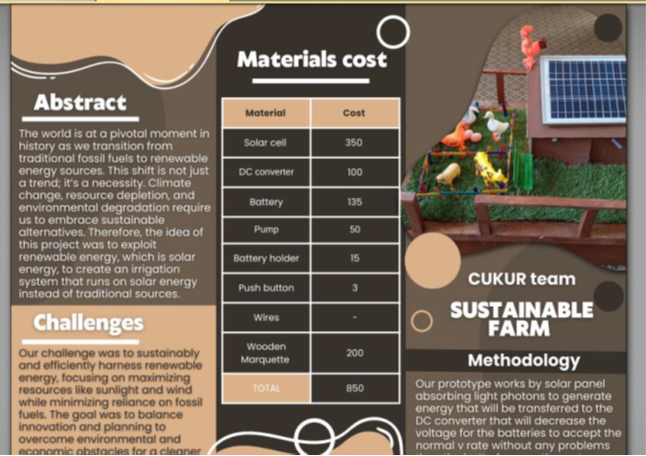
Dr. Ahmed El-Menshawy inspected the student products included in the exhibition, which consisted of applied products based on the academic and theoretical studies conducted by the students throughout their years in the STEM program. These products offered innovative solutions to contemporary societal challenges and problems, using modern technologies, in line with Egypt's Vision 2030. Examples included: a staircase project for generating electricity, an electronic application project for kidney dialysis patients, a plastic tile project resulting from the recycling of plastic waste, a device project for re-purifying electricity, a furnace project for burning waste and generating electricity, and a solar-powered farm project (STEM students' projects.pdf).
Dr. Ahmed El-Menshawy praised the student projects featured in the exhibition, which highlighted the students' creative and scientific skills and their ability to apply their theoretical studies in the form of practical projects that contribute to solving contemporary societal and environmental problems. He affirmed that the exhibition is an opportunity to qualify student cadres for the labor market and to refine their talents and skills in implementing projects, thus benefiting society and promoting sustainable development. These projects were inaugurated in the exhibition opened by Professor Dr. El-Menshawy, the University President."
"STEM students also presented an innovative idea for extracting groundwater by generating electricity from sunlight using an LED."
And other projects in various fields can be viewed through the following link
The projects implemented at the university to address climate change: A total of 7 projects will be executed at a total cost of 1.5 million euros as part of the "Improving Energy Efficiency in University Buildings" project, which involves 18 Egyptian public universities under the supervision of the Supreme Council of Universities and funded by the German Reconstruction Bank (KFW). These projects are considered models that can be expanded in the future at the level of Assiut University and will lead to a reduction in consumption by approximately 3.2 gigawatt-hours. The green projects, which emerged from the initiative of Assiut University, were adopted, where two teams of students from the Assiut University Green Initiative won second and fourth places during their participation in the global "Climathon" conference, organized by the Ministry of Environment in collaboration with the European Union and the German International Cooperation Agency in Egypt on October 30 and 31, 2023, under the title "Climathon Upper Egypt - Towards Localizing the National Climate Change Strategy Egypt 2050." This was under the supervision of Professor Dr. Ahmed El-Manshawi, President of the University, and Professor Dr. Mahmoud Abdel-Aleem, Vice President of the University for Community Service and Environmental Development. The participation of Assiut University in the activities of the Climate Summit of Upper Egypt came within the framework of efforts aimed at achieving sustainable development in the context of implementing Egypt Vision 2030, through environmental preservation to improve the quality of life, considering the rights of future generations, and implementing the National Climate Change Strategy 2050.
•The team (Eco-Fuel Innovators) won second place for their project on recycling solid agricultural waste, especially rice straw, sorghum husks, and other agricultural residues that farmers burn, leading to the emission of harmful greenhouse gases and resulting in environmental pollution. The student team includes:
Shamous Abdel-Sami (Faculty of Science), Dina Gamal Abdel-Nasser (Faculty of Engineering), and Bula Francis Habib (Faculty of Engineering).
The concept of Eco-Fuel is based on recycling solid agricultural waste, especially rice straw, fine corn husks, and other agricultural residues that farmers burn, leading to the emission of harmful greenhouse gases and resulting in environmental pollution. By using anaerobic bacteria and the fermentation process, these residues are converted into biogas as a primary product and other secondary products such as animal feed. • The team (Blast-tech) also won fourth place for their project on extracting diesel fuel from plastic through pyrolysis and processing to produce environmentally safe fuel, reduce carbon emissions resulting from plastic waste accumulation, and mitigate climate change. The student team includes: Yusuf Mohamed (Faculty of Engineering), Nuran Alaa El-Din (Faculty of Agriculture), and Zainab Abdel-Mawla (Faculty of Medicine). • The University of Assiut also encouraged one of the green project teams to implement the "Liquid Tree" project, which revolves around creating a container that holds 600 liters of water. Microalgae use carbon dioxide and produce pure oxygen through photosynthesis. In this way, the Liquid Tree is considered a tangible and effective solution to reduce emissions and improve air quality in densely populated cities where green spaces may be limited. The initiative of Assiut University Green aims to raise environmental awareness among students and university staff regarding sustainability, in addition to implementing work strategies to mitigate the impact of climate change for the benefit of our community.
Assiut University's Carbon Neutrality Strategy: The university has developed a strategy to achieve "zero carbon emissions" on campus, aiming to make Assiut University a carbon-neutral campus through the following steps
Current Carbon Footprint Assessment:
Conducting a precise evaluation of the university’s current carbon emissions.
Analyzing the primary sources of emissions (electricity, transportation, building consumption, etc.).
Adoption of Clean Technology:
Utilizing renewable energy technologies and systems, such as solar and wind energy.
Investing in improving building energy efficiency and using green building techniques.
Enhancing Transportation:
Promoting the use of public transportation and encouraging environmentally friendly transportation, such as bicycles and electric vehicles.
Encouraging carpooling among students and staff.
Waste Management:
Improving waste management, recycling, and proper waste disposal processes.
Promoting a Culture of Sustainability:
Raising awareness among students and staff on the importance of sustainability and how they can contribute to reducing carbon emissions.
Organizing events and workshops on environmental topics.
Partnerships with the Local Community:
Collaborating with local entities to advance sustainability and secure financial and technical support.
Continuous Evaluation and Monitoring:
Periodically assessing the university’s progress toward achieving the target.
Monitoring environmental performance and documenting improvements and challenges.
By implementing this plan, the university can achieve its goal of a carbon-neutral campus and contribute to local and global environmental sustainability.
Tree Planting for Climate Adaptation: The university is planting trees to absorb CO₂, leveraging the process of photosynthesis, in which trees use sunlight to absorb CO₂ and convert it into sugars and oxygen.
Estimated Carbon Absorption by Trees: Based on tree species and environmental conditions, large trees such as oak and pine can absorb significant amounts of CO₂ (ranging from approximately 10–30 kg of CO₂ per tree per year).
Carbon Absorption by Tree Type:
Pine: Large pines can absorb approximately 21 kg of CO₂ annually.
Eucalyptus: A mature eucalyptus tree can absorb about 25 kg of CO₂ annually.
Oak: Mature oaks can absorb about 15–20 kg of CO₂ per year.
Beech: Large beech trees can absorb around 20–30 kg of CO₂ per year.
Cedar: Mature cedar trees absorb approximately 20–25 kg of CO₂ annually.
Palm: Mature palms can absorb around 20 kg of CO₂ annually.
These are estimated values that may vary depending on environmental conditions and other factors. In addition to carbon absorption, smaller trees and shrubs also contribute to environmental improvement.
Additional Environmental Benefits of Tree Planting: Beyond CO₂ absorption, tree planting improves air quality, provides shade, enhances the local environment, reduces dust accumulation, and provides habitats for wildlife.
Duration of Impact: Tree planting represents a long-term investment in environmental improvement and emission reduction, with effects lasting for decades.
Impact Factors: Tree species, growth conditions (such as temperature and humidity), and vegetation density all influence a tree's CO₂ absorption efficiency.
Tree Planting Initiatives at Assiut University under the "Go Green" Initiative:
In 2021, 4,000 Jojoba trees were planted at the Faculty of Agriculture's demonstration farm, in collaboration with the Egyptian-Gulf Agricultural Land Company.
In 2023, a nursery for mahogany trees—high-quality wood for furniture making—was established, utilizing wastewater/industrial drainage/well water.
During the 2022/2023 academic year, 655 fruit trees and 612 non-fruit trees were planted across the Assiut University campus.
Under the presidential "100 Million Trees" initiative, 1,000 fruit trees were planted at Assiut University during the 12th International Conference on Development and the Environment in the Arab World, held from February 25–27, 2024.
Assiut University hosts an environmental seminar on the "Carbon Footprint" as part of the events of the First Student Green Dream Conference.
Assiut University hosts an environmental seminar on the "Carbon Footprint" as part of the events of the First Student Green Dream Conference (November 2023).

Collaborate with NGOs on climate adaptation Report