
November 19, 2025
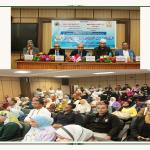
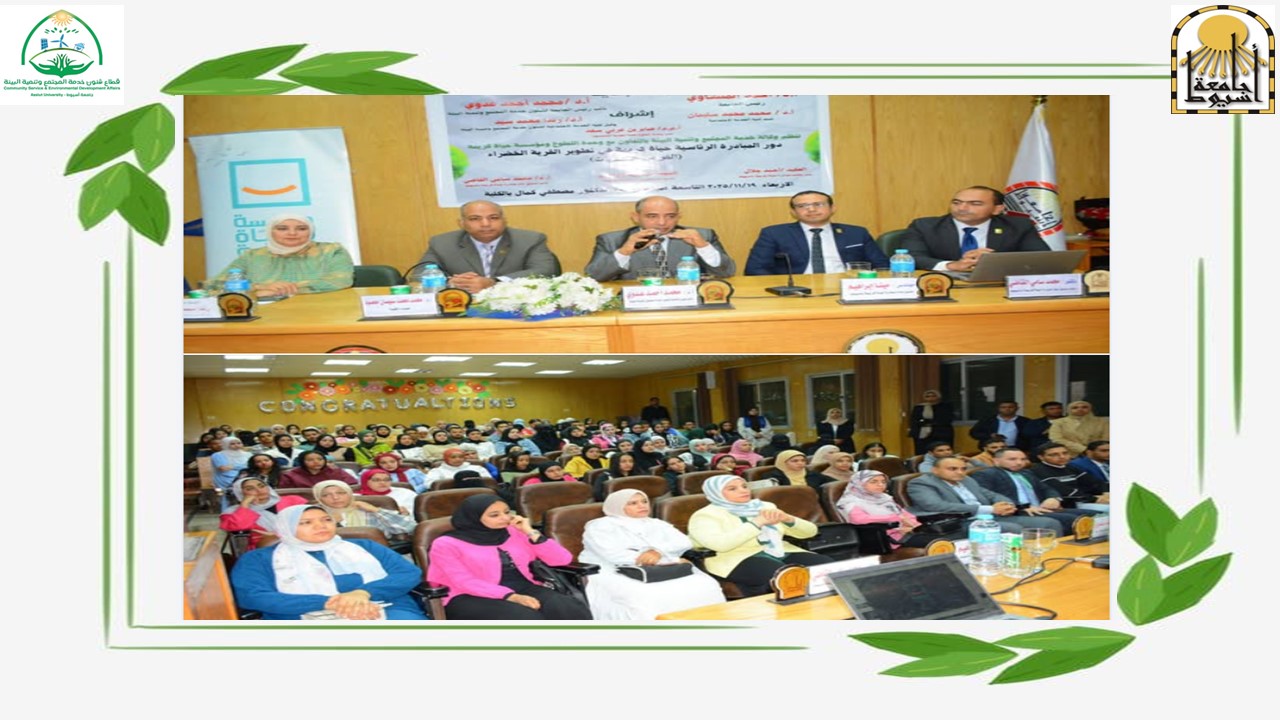
The Faculty of Social Work at Assiut University organized on Wednesday, 19 November, a symposium titled “The Role of the Presidential Initiative Haya Karima in Developing the Green Village (Opportunities – Challenges)”. The event was held under the patronage of Professor Ahmed El-Minshawy, President of Assiut University, and in cooperation with the Haya Karima Foundation, with the attendance of Professor Mohamed Ahmed Adawy, Vice President for Community Service and Environmental Development.
The symposium was convened under the supervision of Professor Mohamed Mohamed Suleiman, Dean of the Faculty of Social Work; Dr. Randa Mohamed Sayed, Vice Dean for Community Service and Environmental Development; and Dr. Sabrin Arabi Saad, Director of the Faculty’s Volunteer Unit. The event also featured the participation of Engineer Mina Ibrahim, General Coordinator of the Haya Karima Initiative in Assiut, and Dr. Mohamed Sami Al-Qadi, Deputy General Coordinator of the Initiative in the governorate.
Professor El-Minshawy affirmed that the Presidential Initiative Haya Karima is one of the most significant national initiatives that has brought about a major transformation in developing rural Egypt. He noted that the wide-ranging improvements in services and infrastructure achieved through the initiative provide a unique model of integrated development that places citizens at the heart of its priorities. He added that Assiut University supports the initiative through its academic and research expertise, its participation in medical, veterinary, and awareness convoys, and by encouraging student involvement in volunteer work.
The University President added that organizing this symposium reinforces the university’s role in community service and in raising awareness of national efforts aimed at building the New Republic. He emphasized that the university remains a key partner in supporting national initiatives that seek to enhance the quality of life for citizens across the governorate’s villages and districts.
For his part, Professor Mohamed Adawy highlighted the strong cooperation between Assiut University and the Haya Karima Foundation across its various areas of work. He noted the university’s significant contribution through its participation in free medical, veterinary, and awareness convoys serving many villages in the governorate. He added that a large number of university affiliates have volunteered under the initiative to support rural development, calling for additional activities to introduce students to the initiative’s achievements and encourage broader participation in its programs.
Professor Suleiman explained that the symposium aims to explore the initiative’s role in developing Egyptian villages as one of the most important national projects of the New Republic and its Sustainable Development Vision 2030. He emphasized that the symposium serves as a valuable platform for exchanging expertise and strengthening collaboration between the academic community, university youth, and civil society in support of this national effort.
In this context, Dr. Randa Mohamed Sayed stated that the Haya Karima Initiative represents a turning point in the development of rural Egypt. She noted that the initiative has launched integrated projects in infrastructure, healthcare, education, women’s and youth empowerment, housing development, and essential services, contributing to improved quality of life for millions. She added that the initiative has targeted 22 million citizens across 20 governorates, covering 1,477 villages in its first phase and 1,667 villages in the second.
Engineer Mina Ibrahim emphasized that the core mission of Haya Karima is human development, which is reflected in the comprehensive services it provides to rural communities. He highlighted the initiative’s achievements in Assiut villages, including upgrades to water and sanitation networks, schools, hospitals, road paving, and the provision of high-speed internet in several villages.
Dr. Al-Qadi expressed his gratitude to the administration of Assiut University and the Faculty of Social Work for their continuous cooperation with the Haya Karima Foundation in development efforts and awareness activities—including this symposium, which aims to familiarize students with the initiative. He encouraged students to engage in volunteer work through the initiative to contribute to the advancement of rural Egypt and the betterment of society.