

November 17, 2025
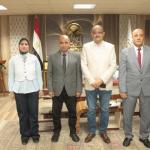
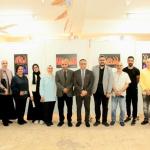
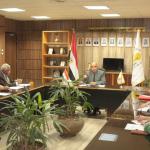
Professor Ahmed El-Minshawy, President of Assiut University, inaugurated the activities of the “Green Footprint” initiative this morning, Monday, 17 November, by planting a tree in the courtyard of the Faculty of Agriculture, with the participation of students with disabilities alongside students from the Faculty of Agriculture. The initiative was organized by the Center for Students with Disabilities in cooperation with the Faculty of Agriculture, reflecting the university’s commitment to promoting inclusion, environmental responsibility, and collaborative work. The event was held under the supervision of Professor Ahmed Abdel-Mawla, Vice President for Education and Student Affairs; Professor Adel Mohamed Mahmoud, Dean of the Faculty of Agriculture; and Dr. Omnia Mohamed Ibrahim, Director of the Center for Students with Disabilities.
The event was attended by:
- Professor Adel Tammam, Vice Dean for Education and Student Affairs
- Professor Galal Abdel-Fattah, Vice Dean for Community Service and Environmental Development
- Professor Mohamed El-Sagheer, Vice Dean for Postgraduate Studies and Research
- Professor Karam Abdel-Naeem, Head of the Department of Genetics and General Supervisor of the Central Laboratories
- Dr. Mohamed Abdel-Karim, Professor in the Department of Plant Protection
- Ms. Rehab Oweida, Faculty Secretary
- Dr. Gamal El-Sawy, Administrative Director of the Center
- Dr. Mohamed Yassin, Activities Coordinator
- Engineer Lamia Abdel-Halim, IT Officer
Professor El-Minshawy affirmed that the “Green Footprint” initiative is part of the university’s strategic plan to advance the concept of a sustainable university in line with Egypt’s Vision 2030. He underscored the university’s commitment to expanding green spaces due to their direct impact on improving the campus environment, enhancing public health, and raising awareness of sustainability and climate change. He also emphasized that the initiative reflects the university’s dedication to integrating and empowering students with disabilities by providing them with full opportunities to participate in various activities.
The University President explained that the initiative carries an environmental, societal, and developmental message aimed at instilling values of giving, belonging, and responsibility among students, while fostering an inclusive educational environment that offers equal opportunities for learning and participation. He reiterated the university’s commitment to continuing programs and initiatives that strengthen environmental awareness and student engagement.
Professor Abdel-Mawla praised the active role played by the Center for Students with Disabilities and the university’s faculties in supporting and empowering students, noting the university’s efforts to provide an inclusive educational environment that helps students discover their abilities and develop their skills.
For his part, Professor Adel Mahmoud noted that the initiative represents a successful model of integration across the university’s units, combining environmental, social, and developmental dimensions while offering students meaningful opportunities to participate in sustainability projects and green cultivation activities.
Professor Omnia Mohamed Ibrahim explained that the initiative involves distributing student groups to plant green areas in front of the Faculty of Agriculture, with each planted site serving as a practical model for inclusion and student creativity.
The initiative includes several key components, including:
- Agricultural Education: introductory workshops led by faculty members from the Faculty of Agriculture on the basics of planting and plant care.
- Environmental Awareness: sessions highlighting the importance of tree planting and its role in reducing pollution.
- Fieldwork: assigning students to plant trees as well as medicinal, aromatic, and flowering plants.
- Maintenance and Follow-up: preparing a regular schedule for caring for the newly planted areas.
- Initiative Visibility: installing informational signs in the planted areas featuring the names of participating students and the initiative’s logo.