 Do you have any questions?

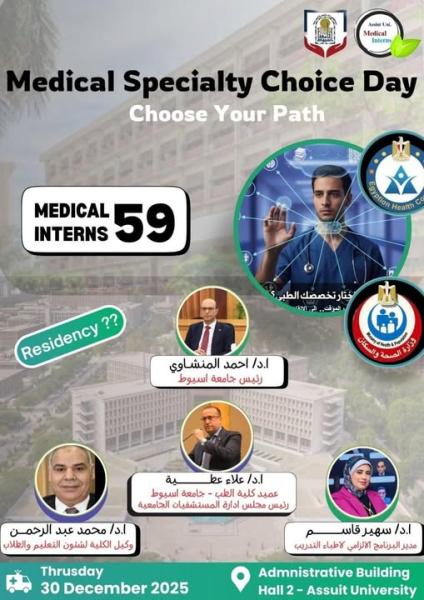
The Faculty of Medicine at Assiut University organizes a scientific day on how to choose a specialty for doctors of the 59th batch.
Mirabegron is a beta 3-adrenoceptor agonist that can help with incontinence, dysuria, and bladder overactivity. It alleviates the symptoms of prostate enlargement and urinary tract infections (UTIs) in the elderly. We aimed to explore Mirabegron’s antimicrobial and immune-boosting properties, trying to benefit people suffering from urinary tract infections and having an overactive bladder. Mirabegron’s putative antibacterial activity was investigated using the well diffusion method (In Vitro). Infected rats were treated with mirabegron (10 mg/kg, oral) and used for evaluation of immunomodulatory actions (In Vivo). We tested the antibacterial activity in vitro against numerous bacterial strains, including Escherichia coli (E. coli). The phagocytic activity and survival of peritoneal macrophages were examined. Also, serum levels of immunoglobulin G (IgG), immunoglobulin M (IgM), and interferon-γ (INF-γ) were estimated in E. coli-infected rats. We found that mirabegron exhibited significant antibacterial activity, particularly against E. coli. Phagocytic activity increased notably in vivo, indicating an improved innate immune response. Mirabegron also demonstrated a substantial rise in immunoglobulin and cytokine levels, enhancing acquired immunity. According to our findings, in vitro and in vivo tests of mirabegron revealed possible antibacterial activity as well as immunomodulatory properties. Mirabegron could alleviate symptomatic UTIs.
Fibromyalgia syndrome (FMS) is a chronic, multidimensional musculoskeletal condition distinguished by severe nociceptive dysfunction, persistent fatigue, sleep disruptions, cognitive deficits, and emotional instability. Although valproic acid (VPA) has been used to treat epilepsy and bipolar disorder, its efficacy in altering neuropathic pain pathways remains unclear. In this investigation, we assessed the neuromodulatory characteristics of VPA (300 mg/kg, intraperitoneally) in an established FMS rat model, with a focus on neuroinflammation, oxidative stress, and glial activation. Behavioral evaluations for thermal hyperalgesia (paw withdrawal latency, PWL) and mechanical allodynia (paw withdrawal threshold, PWT) were performed at baseline (day 0), after induction (day 5), and at various intervals following VPA administration. Neurochemical evaluations demonstrated that VPA markedly diminished FMS-induced elevations in malondialdehyde (MDA), nitric oxide (NO), and pro-inflammatory cytokines such as tumor necrosis factor-α (TNF-α), interleukin (IL)-1β, and interleukin (IL)-6, while restoring antioxidant defenses, such as glutathione (GSH) and superoxide dismutase (SOD). Histopathological examination demonstrated reduced neuronal degeneration and decreased immunoreactivity of glial fibrillary acidic protein (GFAP). These findings indicate that VPA reduces FMS-related pain and neuroinflammatory characteristics through antioxidative and glial-modulating mechanisms, indicating its potential for therapeutic repurposing in neuropathic pain syndromes.
Acute kidney injury and other renal disorders are thought to be primarily caused by renal ischemia-reperfusion (RIR). Cyclic adenosine monophosphate (cAMP) has plenty of physiological pleiotropic effects and preserves tissue integrity and functions. This research aimed to examine the potential protective effects of the β3-adrenergic receptors agonist mirabegron in a rat model of RIR and its underlying mechanisms. Male rats enrolled in this work were given an oral dose of 30 mg/kg mirabegron for two days before surgical induction of RIR. Renal levels of kidney injury molecule-1 (KIM-1), monocyte chemoattractant protein-1 (MCP-1), tumor necrosis factor-alpha (TNF-α), Interleukin-10 (IL-10), cAMP, cAMP-responsive element binding protein (pCREB), and glycogen synthase kinase-3 beta (GSK-3β) were assessed along with blood urea nitrogen and serum creatinine. Additionally, caspase-3 and nuclear factor-kappa B (NF-κB) p65 were explored by immunohistochemical analysis. Renal specimens were inspected for histopathological changes. RIR led to renal tissue damage with elevated blood urea nitrogen and serum creatinine levels. The renal KIM-1, MCP-1, TNF-α, and GSK-3β were significantly increased, while IL-10, cAMP, and pCREB levels were reduced. Moreover, upregulation of caspase-3 and NF-κB p65 protein expression was seen in RIR rats. Mirabegron significantly reduced kidney dysfunction, histological abnormalities, inflammation, and apoptosis in the rat renal tissues. Mechanistically, mirabegron mediated these effects via modulation of cAMP/pCREB and GSK-3β/NF-κB p65 signaling pathways. Mirabegron administration could protect renal tissue and maintain renal function against RIR.
Toxoplasma gondii infection remains a significant global health concern, promoting the urgent need
for effective therapeutic strategies. This study aimed to evaluate the therapeutic potential of chitosan
nanoparticles (CSNPs) and curcumin-loaded chitosan nanoparticles (Cur-CSNPs) against the chronic
Toxoplasma gondii (ME49 strain) in an experimental mouse model. This achieved by investigating
their ability to reduce parasitic load, oxidative stress, histopathological lesion, and to enhance the
host immune response. Sixty female BALB/c mice were divided into five groups: infected untreated
group, Spiramycin®-treated group, CSNPs-treated group, Cur-CSNPs-treated group, and negative
control group. The Cur-CSNPs-treated group exhibited the lowest brain cyst counts, along with
significant reductions in cyst size. Hematological indices revealed no significant reduction in total
white blood cell (WBC) counts or in the percentage of neutrophils, monocytes, and eosinophils in
both the CSNPs and Cur-CSNPs treated groups, compared to the infected untreated group and
Spiramycin-treated group. However, both nanoparticle-treated groups exhibited a significant decrease
in the percentage of lymphocytes compared to the infected untreated group. Significant differences
in total antioxidant capacity (TAC) and malondialdehyde (MDA) levels were observed, with the
Cur-CSNPs treated group displaying values comparable to the negative control. Histopathological
examination revealed substantial improvements in the brain, liver, and spleen tissues of Cur-CSNPstreated
animals, characterized by preserved tissue architecture and reduced inflammatory lesions.
Immunohistochemical analysis further revealed reduced expression of IL-6 and TNF-α, indicating a
mitigated inflammatory response. These findings highlight the promising therapeutic role of Cur-
CSNPs in controlling chronic T. gondii infection and suggest their potential as a novel strategy for
developing effective antiparasitic treatments.
Keywords Toxoplasma, Curcumin, Chitosan nanoparticles, Oxidative stress, TNF-α, Histopathological
lesions
is frequent, loose, or watery bowel movements (BMs) that differ from a child's normal
pattern, as is a very common problem, leading cause of child mortality and morbidity worldwide.
In children acute watery diarrhea (several hours or days), acute bloody diarrhea (dysentery), and
persistent diarrhea, which lasts 14 days or longer. Gastroenteritis most common symptoms regardless
of cause, are vomiting, diarrhea, and sometimes abdominal cramps, fever, and poor appetite.
The risky complication of gastroenteritis is dehydration. The dehydrated children become listless,
irritable, or sluggish (lethargic), but dehydrated infants develop serious side effects with hospitalized
medical care. The causative agents of diarrhea in children are viruses, particularly rotavirus
(preventable with a vaccine) and norovirus, as well as adenovirus and arbovirus, bacteria
like E. coli, salmonella and cholera. Protozoal parasites causing diarrhea as Cryptosporidium, Entamoeba,
Giardia, Balantidium coli and Cystoisospora belli as well as helminths as Strongyloides,
Schistosoma and Trichuris may cause chronic diarrhea especially in immunocompromised individuals.
Apart from microorganism agents, diet, antibiotics and others can cause children diarrhea.
Key words: Children, Diarrhea, Pathogenesis, Bacteria, Parasites, Viruses, Others