
N- or/and P-deprived Coccomyxa chodatii SAG 216–2 extracts instigated mercury tolerance of germinated wheat seedlings

Research Abstract

Purpose

This research studies the alleviation potential of N- or/and P- deprived Coccomyxa chodatii SAG 216–2 extracts as biostimulants on mercury stress (10 and 30 mg L−1) of wheat seedlings.

Materials

The study includes the interactive effect of mercury and biostimulants on growth, reactive nitrogen and oxygen species, membrane stability, and antioxidant activity in wheat seedlings.

Results

The imposed toxic effects of Hg-stress on the studied parameters were to a great extent less noticeable under different algal extracts, and the magnitude of augmentation was P-deprived extract > P-&N-deprived extract > N-deprived extract > Normal algal extract. Higher Hg-tolerance modulated by algal extracts, especially P-deprived extract, was associated with high antioxidant capacity and ferric reducing power. These activities could instigate the antioxidant system (enzymatic and non-enzymatic) under Hg-stress …
Research Authors
Mona FA Dawood, Mahmoud R Sofy, Heba I Mohamed, Ahmed R Sofy, Huwida AA Abdel-Kader
Research Date
Research Journal
Plant and Soil
Research Pages
225-253
Research Publisher
Springer International Publishing
Research Vol
483
Research Year
2023

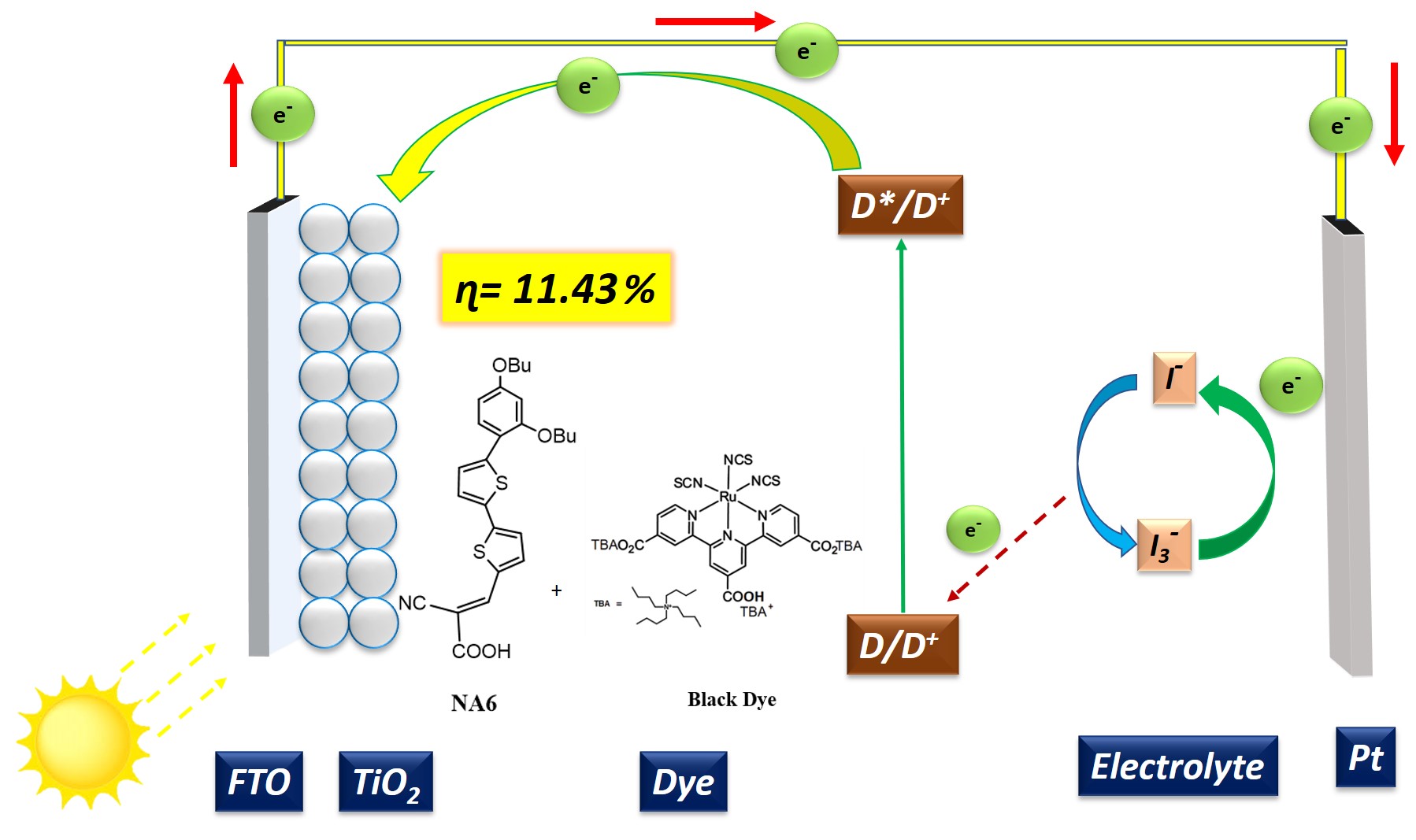
Tuning of spectral response in dye-sensitized solar cell by co-sensitization of black dye with small organic photosensitizers

Research Abstract

A series of efficient donor-π-acceptor tiny organic dyes NA1, NA6, and NA7 were developed as co-sensitizers to improve the photovoltaic performance of the black dye-based dye-sensitized solar cells (DSCs). Dye aggregation on the TiO2 surface was reduced, and improved sensitizer coverage was achieved through the introduction of a long alkoxy group in the donor part, the tuning of the anchoring parts, and the π-spacer of the co-sensitizer NA6. The spectral photoresponse was thereby dramatically improved across the spectrum from the ultraviolet to the visible range, and the recombination process was suppressed for the (black dye+NA6) co-sensitized cell compared with a single black dye. The co-sensitized black dye+NA6-based DSCs show a considerable increase in Voc (open-circuit voltage), Jsc (short-circuit current density), and FF (fill factor) to 721 mV, 21.64 mAcm−2 and 0.733, respectively. A higher efficiency of 11.43% was, consequently, achieved for the (black dye+NA6) co-sensitized cell compared to 10.56% for the DSCs based on a single black dye.

Research Authors
Nazir Mustapha, Muhammad Abdel-Shakour , Idriss Bedja & M. Abdel Rafea
Research Date
Research Department
Research Image
Research Journal
Journal of Materials Science: Materials in Electronics
Research Pages
2012
Research Publisher
springer
Research Vol
34
Research Website
https://link.springer.com/article/10.1007/s10854-023-11449-9#Abs1
Research Year
2023

Synthesis and thermal studies of mixed ligand complexes of Cu(II), Co(II), Ni(II) and Cd(II) with mercaptotriazoles and dehydroacetic acid

Research Authors
Dina M. Fouad, Ahmed B.M. Ibrahim, Mohamed A. El-Gahami, Said A. Ibrahim, Abbas M. Hammam
Research Journal
Natural Science
Research Pages
817-827
Research Vol
2(8)
Research Year
2010

Synthesis and thermal studies on new Co(II), Ni(II), Cu(II) and Cd(II) mixed ligand complexes with 3-benzyl-4-amino-1,2,4-triazole-5-thione Schiff bases and α,α'-bipyridyl

Research Authors
Dina M. Fouad, Ahmed B.M. Ibrahim, Mohamed A. El-Gahami, Said A. Ibrahim, Abbas M. Hammam
Research Journal
Analytical Chemistry - An Indian Journal
Research Pages
13-23
Research Vol
10(1)
Research Year
2011

New iron(III) complexes with 2-formylpyridine thiosemicarbazones: Synthetic aspects, structural and spectral analyses and cytotoxicity screening against MCF-7 human cancer cells

Research Authors
Amany Fathy, Ahmed B.M. Ibrahim, S. Abd Elkhalik, Alexander Villinger, S.M. Abbas
Research Date
Research Department
Research Journal
Heliyon
Research Pages
e13008
Research Vol
9(1)
Research Year
2023

A novel trinuclear nickel(II) salicylaldimine complex: Synthesis, structural characterization, bioactivity profile against bacterial, fungal and breast cancer cells and effects on wheat germination indices

Research Authors
Ereny S. Williem, Ahmed Amro, Ahmed B.M. Ibrahim, S. Abd Elkhalik, Peter Mayer, S.M. Abbas
Research Date
Research Department
Research Journal
Crystals
Research Pages
1084
Research Website
13(7)
Research Year
2023

Response to oxidative stress generation in Rhodotorula glutinis and Candida tropical by thallium dithiocarbamate complexes

Research Authors
Ghada Abd-Elmonsef Mahmoud, Peter Mayer, Dalia A. Gaber, Ahmed B.M. Ibrahim
Research Date
Research Department
Research Journal
Inorganic Chemistry Communications
Research Pages
111283
Research Vol
156
Research Year
2023

In vitro biological activity of cobalt(II) complexes with salicylaldimine ligands in microbial and cancer cells

Research Authors
Ereny S. Williem, Ahmed B.M. Ibrahim, S. Abd Elkhalik, Jaromír Marek, S.M. Abbas
Research Date
Research Department
Research Journal
Future Medicinal Chemistry
Research Pages
1415-1426
Research Vol
15
Research Year
2023

Application of Aspergillus oryzae ASU44 (OL314732) and their kojic acid as pesticides against cotton aphid, Aphis gossypii.

Research Abstract

Because of their negative effects on the environment, humans, and other organisms, chemical pesticides have been prohibited in many countries. Alternative microbial management is easy-to-implement, effective, and safe for humans and the environment. Fungus-based biopesticide products like kojic acid could commercialize as effective alternative chemical pesticides. Aspergillus oryzae ASU44 (OL314732) was isolated from hollyhock rhizosphere and identified using 18S rRNA gene sequencing. The strain showed high ability of kojic acid production especially after optimizing the production using 41-run Box-Behnken statistical design. Maximum kojic acid production was 46.53 g/l (predicted values 46.62 g/l) obtained in run number (23) using Glucose (150, g/l), Yeast extract (5 g/l), KH2PO4 (3 g/l), MgSO4.7H2O (0.5 g/l) and pH (3). The design was effective to applied with coefficient (R2) 0.988, 0.986 (adjusted R2 0.975, 0.972) for kojic acid (g/l) and dry fungal mass formation (g/l). The pathogenicity of the fungus and their kojic acid in addition to standard synthetic kojic acid was investigated to the cotton aphid, Aphis gossypii Glover (Homoptera: Aphididae). All treatments had a considerable impact on aphid mortality. The mortality rate was relative to the duration of exposure and the quantities of bio-pesticides agents. However, data revealed that as concentrations increased, the lethal time values decreased . Aspergillus oryzae ASU44 and its extract containing kojic acid were found effective against A. gossypii. As a result, this research suggests that these agents could be effective in aphid cotton management.  
 

Research Authors
Ghada A. Mahmoud; Abdel- Naser A. Zohri; Nahla Kamal-Eldin; Nourelhoda Abdelhamid
Research Date
Research Journal
Bull. Pharm. Sci., Assiut University
Research Pages
63 - 82
Research Publisher
Pharm. Sci., Assiut University
Research Vol
46 (1)
Research Website
Website: http://bpsa.journals.ekb.eg/
Research Year
2023

Production of Cocktail Enzymes by Three Cladosporium Isolates and Bioconversion of Orange Peel Wastes into Valuable Enzymes

Research Abstract

The current research demonstrates the biotechnological economization of accumulated and inefficiently used agro-industrial orange peel wastes to generate amylase, endoglucanase, exoglucanase, pectinase, and xylanase, industrially essential enzymes with growing demands in enzyme markets, from three Cladosporium isolates. In submerged fermentation (SmF) at 10°C, the isolate AUMC 10865 produced the highest level of amylase (4164 IU/gram dry substrate). Endoglucanase, exoglucanase and xylanase had development peaks (923 IU/gds, 2280 IU/gds, and 1646 IU/gds, respectively in case of Cladosporium sp. AUMC 11366. Pectinase produced the most (7840 IU/gds) in the strain AUMC 11340. At 30°C, the strain AUMC 11340 secretes the most amylase (4120 IU/gds), endoglucanase (2700 IU/gds) and xylanase (3220 IU/gds). Exoglucanase development reached the peak (8750 IU/gds) in the isolate AUMC 10865. The overall production (5570 IU/gds) was instead enhanced by pectinase in the AUMC 11366 isolate. In solid-state fermentation (SSF) at 10°C, the isolate AUMC 10865 outperformed the other two isolates producing 640.0 IU/gds amylase, 763.3 IU/gds endoglucanase, 771.0 IU/gds exoglucanase, 1273.23 IU/ gds pectinase and 1062.0 IU/gds xylanase, while the isolate AUMC 11366 produced the least amount of 399.7 IU/gds, 410.0 IU/gds, 413.3 IU/gds, 558.7 IU/gds, and 548.0 IU/gds, respectively. At 30°C, the isolate AUMC 11340 was superiorly producing higher levels of amylase (973.3 IU/gds), endoglucanase (746.0 IU/gds), exoglucanase (1052.0 IU/gds), pectinase (1685.3 IU/gds) and xylanase (1340.0 IU/gds), whereas isolate AUMC 10865 generated the least amounts of amylase (556.7 IU/gds) and exoglucanase (452.7 IU/gfs), and the isolate AUMC 11366 produced the least endoglucanase (256.3 IU/gds), pectinase (857.7 IU/gfs) and xylanase (436.3 IU/gds) amounts. 

Research Authors
Ahmad Mohamed Moharram, Abdel-Naser Ahmed Zohri, Abd El-Latif Hesham, Mohamed Al-Ameen Maher and Osama Abdel-Hafeez Mohamed Shaban Al-Bedak
Research Date
Research Journal
J Pure Appl. Microbiol.
Research Pages
2336-2346
Research Vol
15 (4)
Research Website
https://doi.org/10.22207/JPAM.15.4.58
Research Year
2021
Subscribe to