
The University's public events
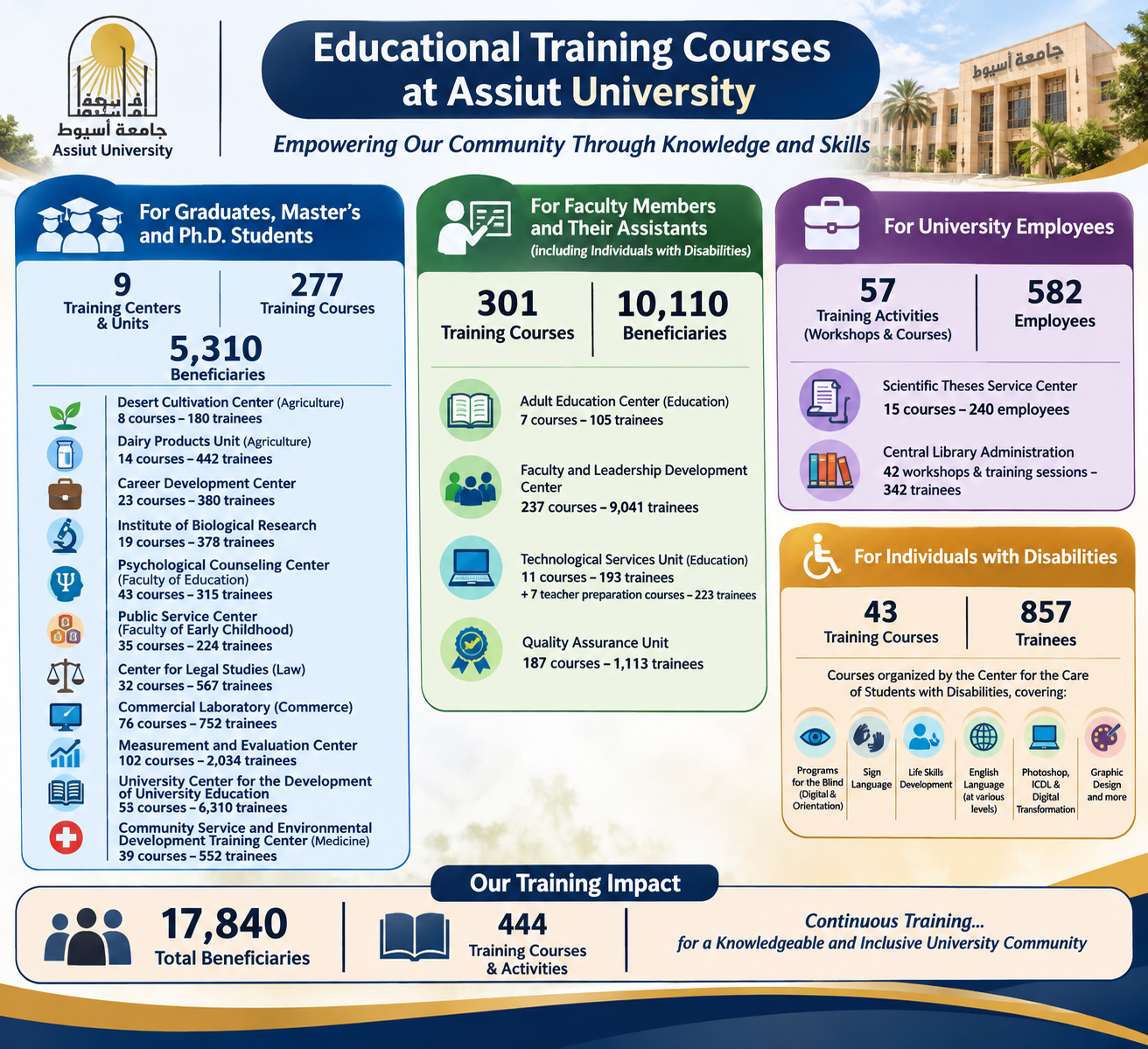
Regarding the educational training courses conducted by the University for graduates, Master's and Ph.D. students, faculty members, and international students (including individuals with disabilities), they are as follows:
The Desert Cultivation Center at the Faculty of Agriculture
- held (8) courses on the planning, installation, and operation of irrigation systems for (180) trainees. Additionally, the Dairy Products Unit at the same faculty organized (14) courses on dairy processing skills for (442) trainees.
The University’s Career Development Center
- held (23) training courses revolving around employability skills, marketing and human resources, project management, occupational safety, and others, with a total attendance of (380) trainees.
Similarly, the Institute of Biological Research
- held (19) educational courses for (378) beneficiaries covering air pollution, infection control, the importance of health safety, promoting anti-addiction awareness, proper nutrition, DNA techniques and analysis, cell and tissue culture, scientific rules for preparing scientific research, and the fundamentals of plant tissue culture.
The Psychological Counseling Center at the Faculty of Education
- held (43) courses on teaching mathematics and science in English, effective teaching skills, and Arabic language courses for non-native speakers, with a total of (315) trainees. The Public Service Center at the Faculty of Early Childhood implemented (35) courses on Montessori, speech therapy at various levels, the enhanced early childhood curriculum, and other courses for (224) trainees.
The Center for Legal Studies at the Faculty of Law organized
- (32) courses with a total of (567) trainees focusing on preparing legal advisors, training lawyers and practical aspects of legal drafting, drafting contracts in English, statements of claim, and others.
- The Commercial Laboratory at the Faculty of Commerce held (76) courses on IC3, MOS, programming, and Python for (752) trainees.
The University’s Measurement and Evaluation Center
- held (102) diverse courses for (2,034) trainees regarding electronic grading, scientific content analysis, specification table preparation, the foundations and methods of evaluation and its ethics, test item preparation, and other courses.
The University Center for the Development of University Education
- held (53) training courses, including university qualification and accreditation courses, credit hours, e-learning courses, systems management, and others, for (6,310) trainees.
The Community Service and Environmental Development Training Center at the Faculty of Medicine
- organized (39) training courses on first aid, assistant technical roles, and infection control for (552) trainees.
As for the courses conducted by the University for faculty members and their assistants (including individuals with disabilities):
- The Adult Education Center at the Faculty of Education organized (7) courses on strategies and skills of excellence and influence, challenges facing leaders in adult education management, preparing certified adult education trainers, and designing educational packages for adult education, for (105) trainees.
- The University’s Faculty and Leadership Development Center organized (237) courses on research ethics, academic leadership programs, analytical and creative thinking, digital transformation, effective communication skills, and other academic courses for (9,041) trainees.
- The Technological Services Unit at the Faculty of Education organized (11) courses on searching through the Knowledge Bank, creating electronic exams, handling the Microsoft Teams platform, and others, for (193) trainees. The faculty also held (7) teacher preparation courses for teaching assistants, targeting (223) trainees.
- The University’s Quality Assurance Unit held (187) courses on course content analysis, measuring the achievement of learning outcomes, course specifications, and other courses for (1,113) trainees.
As for university employees, they were trained by the Scientific Theses Service Center through (15) courses on the linguistic phrasing of scientific theses, targeting (240) employees of the theses service centers across various faculties. Similarly, the Central Library Administration held (42) workshops and training sessions on how to build a professional CV, communication basics and presentation skills, effective communication with individuals with disabilities, Arabic calligraphy, and others, for (342) trainees.
Regarding individuals with disabilities:
The Center for the Care of Students with Disabilities organized a set of training courses for university students and graduates with disabilities, totaling (43) courses for (857) trainees, covering digital transformation programs for the blind, orientation and mobility programs for the blind, sign language, life skills development programs, English language programs at various levels, Photoshop programs, digital transformation and ICDL programs, graphic design programs, and other training.