

Mentoring, Guidance, Psychological, Social, and Academic Support Programs for Underrepresented Groups
Assiut University provides a range of institutional mentoring, guidance, psychological, social, and academic support services through specialized units and centers. These include the Student Research and Social and Psychological Care Unit, the Center for Students with Disabilities, the Psychological and Educational Counseling Center at the Faculty of Education, and academic-support and advising units in the University's faculties.
These services include psychological consultations, assistance in addressing academic and social pressures and challenges, monitoring academic achievement, and promoting the inclusion and participation of students with disabilities in university life.
Student Research and Social and Psychological Care Unit
The Unit organizes awareness-raising activities to improve understanding of psychological and social challenges. For example, in May 2025, it organized a seminar entitled “A Psychopedagogical Perspective on Methods of Dealing with Secondary-School Students,” aimed at supporting young people's mental health and developing the skills of psychological specialists.
Center for Students with Disabilities
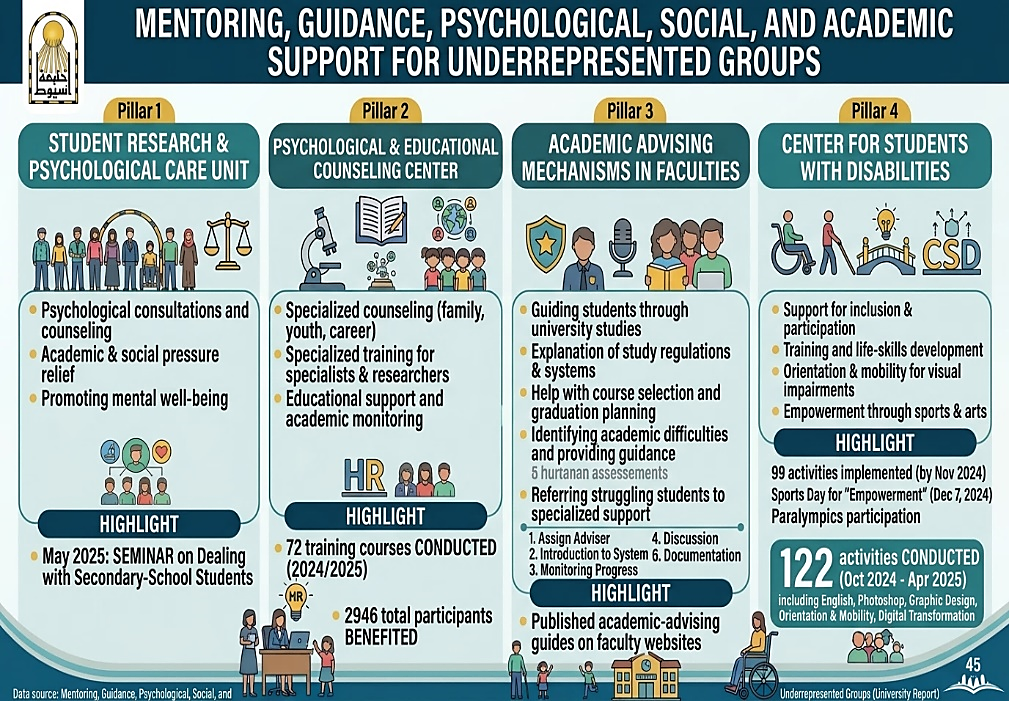 The Center supports the inclusion and participation of students with disabilities through training programs, life-skills development, sports, arts, and educational activities. These initiatives aim to strengthen students' independence, social interaction, and equal opportunities to participate in university life.
In November 2024, the Center announced that it had implemented 99 activities during the 2024/2025 academic year. These included sports, arts, theatre, visual arts, English-language training, Photoshop, graphic design, life skills, and orientation and mobility training for students with visual impairments.
On 7 December 2024, the Center organized a sports day for students with disabilities as part of the “Empowerment” initiative and prepared to participate in the Egyptian Universities Paralympics.
On 16 April 2025, a report stated that approximately 122 activities had been conducted since October 2024. These included awareness-raising, training, sports, and arts programs, digital-transformation programs for students with visual impairments, the “Digital Footprint” initiative, and participation in sports and arts competitions.
Psychological and Educational Counseling Center, Faculty of Education
The Psychological and Educational Counseling Center at the Faculty of Education provides psychological, educational, and social counseling, family and youth counseling, career guidance, and training programs for psychological and social specialists, teachers, and researchers.
These services complement the University's other support mechanisms by promoting student well-being and helping students address psychological, social, and educational challenges.
During the 2024/2025 academic year, (72) training courses were conducted, benefiting (2946) participants.
Academic Advising in University Faculties
The University's faculties also implement academic-advising mechanisms designed to guide and support students throughout their university studies. Students are assigned academic advisers who explain study regulations and academic systems, assist with course selection and planning for graduation, monitor academic progress, identify academic difficulties, and provide guidance to improve performance. These mechanisms also support high-achieving students and refer students to specialized support services when needed.
Academic advising in the University's faculties generally involves the following procedures:
1. Assigning students to academic advisers: Each faculty assigns an adviser to an individual student or group of students and publishes advisers' names and contact details.
2. Introducing students to the study system: New students receive information about academic regulations, examination systems, graduation requirements, and the services available within the faculty.
3. Monitoring registration and study plans: Advisers assist students in selecting and registering for courses and checking that their selections comply with the study plan and graduation requirements under the faculty's regulations.
4. Regularly monitoring academic performance: Advisers review students' achievement and results, discuss difficulties, and recommend appropriate steps to improve performance.
5. Supporting struggling and high-achieving students: Advisers provide assistance to students experiencing academic difficulties and monitor their progress, while encouraging high-achieving and talented students to continue excelling.
6. Referring students to specialized support services: When necessary, students are referred to psychological or social support units or to disability-support services, depending on the services available within the faculty and University.
7. Documentation and evaluation: In faculties that implement these procedures, advising meetings, recommendations, and follow-up actions are documented, and periodic reports are prepared on advising activities and student performance.
faculties also publish academic-advising guides on their official websites.