

Proportion of women receiving degrees
Assiut University seeks to promote gender equality in higher education and provide female students with opportunities to study and graduate across scientific and humanities disciplines. This supports women’s participation in social and economic development and strengthens their role in research, innovation, and the labor market.
As part of monitoring gender-equality indicators, the University tracks the numbers of male and female graduates during the 2024/2025 academic year and analyzes their distribution by field of specialization, including science, technology, engineering, and mathematics (STEM), medical fields, arts, humanities, and social sciences. This makes it possible to assess women’s participation across academic pathways and identify fields with higher numbers of female graduates, supporting planning to expand educational opportunities and strengthen women’s participation in scientific and applied disciplines.
| 5-5-1 | Total number of graduates | 20071 |
|---|---|---|
| 5-1-4 | Total graduates by field: STEM, medicine, arts, humanities, and social sciences | 78355 |
| 5-5-1-1 | Number of graduates in science, technology, engineering, and mathematics (STEM) | 957 |
| 5-5-1-2 | Number of graduates: medicine | 2378 |
| 5-5-1-3 | Number of graduates: arts, humanities, and social sciences | 4500 |
| 5-5-2-4 | Total female graduates by field: STEM, medicine, arts, humanities, and social sciences | 12236 |
| 5-5-2-1 | Number of female graduates: STEM | 837 |
| 5-5-2-2 | Number of female graduates: medicine | 2794 |
| 5-5-2-3 | Number of female graduates: arts, humanities, and social sciences | 8605 |
According to the available data for the 2024/2025 academic year, Assiut University had 20071 graduates in total. . The data clearly shows a predominance of female graduates, with 12,236 women (60.96% of all graduates) compared to 7,835 men (39.04%), reflecting the growing role and participation of women in the educational process.
The data also reveals a disparity in enrollment and distribution across major academic disciplines as follows:
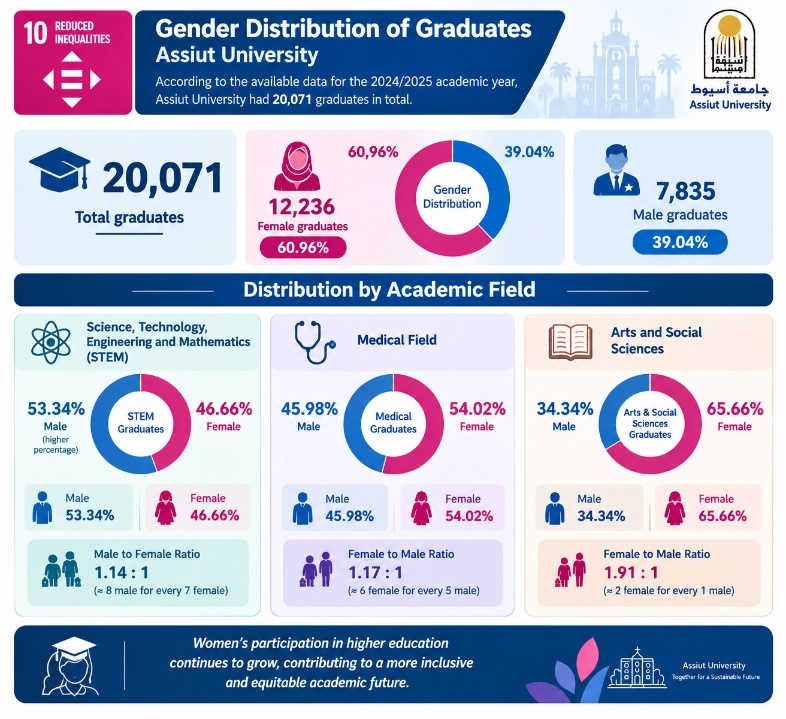
In the Science, Technology, and Mathematics (STEM) sector,
males comprise 53.34% of the total STEM student body, while females represent 46.66%. This sector exhibits a notable gender balance, with a slight male bias. The male-to-female ratio is approximately 1.14:1, meaning roughly 8 male graduates for every 7 female graduates.
In the medical field,
females constitute 54.02% of the total workforce, while males constitute 45.98%. The female-to-male ratio is approximately 1.17:1, meaning roughly 6 female graduates for every 5 male graduates.
In the arts and social sciences field
, females constitute 65.66% of the total workforce, compared to 34.34% for males. The female-to-male ratio is approximately 1.91:1, meaning roughly 2 female graduates for every 1 male graduate.