
10.6.5 human rights on campus

SDG10
Details:

Institutional Body Responsible for Diversity, Equality, Equal Opportunities, Inclusion, and Human Rights

Assiut University has institutional bodies concerned with promoting diversity, equality, equal opportunities, inclusion, and human rights. These include the following:

Equal Opportunities Unit
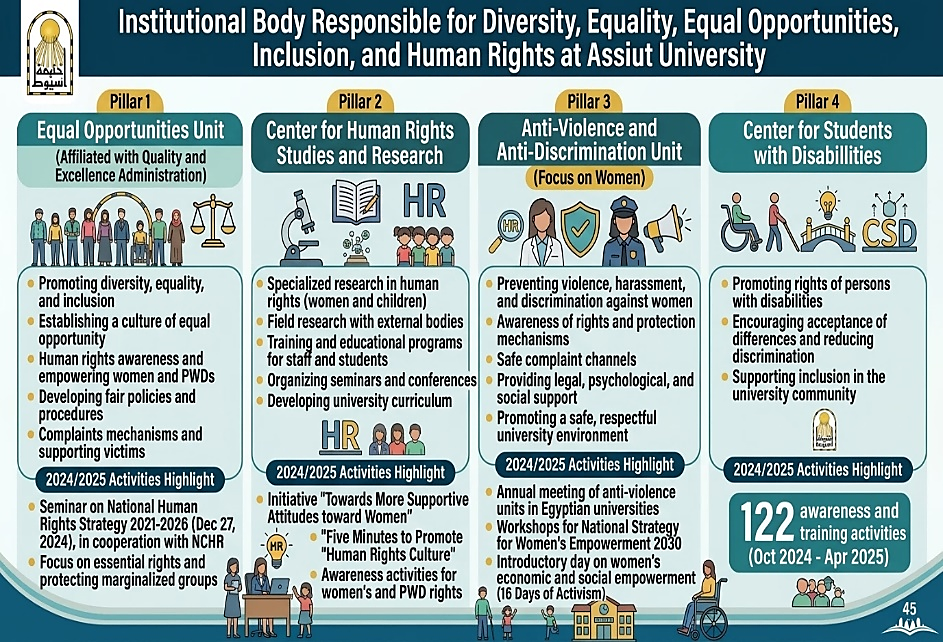
The Equal Opportunities Unit, affiliated with the Quality and Excellence Administration, plays an institutional role in promoting diversity, equality, and inclusion and establishing a culture of equal opportunity and non-discrimination within the university community.

Its responsibilities include raising awareness of human rights and equality, supporting the empowerment of women and persons with disabilities, contributing to the development of policies and procedures that promote justice and non-discrimination, and providing mechanisms for receiving complaints concerning violations of equal opportunities and supporting affected individuals.

As part of the University's human-rights activities during the 2024/2025 academic year, the University hosted an educational seminar on 27 December 2024 on the National Human Rights Strategy 2021–2026, in cooperation with the Human Rights and Equal Opportunities Unit at the Ministry of Finance and the National Council for Human Rights. The seminar addressed fundamental rights and ways to protect groups most vulnerable to marginalization, thereby strengthening institutional awareness of human rights, equality, and inclusion.

- The Center for Human Rights Studies and Research aims to conduct specialized studies and research in human rights, with a focus on the rights of women and children. It also undertakes field research in cooperation with government bodies and University research centers, develops and implements human-rights training and educational programs for university employees, relevant government bodies, and students, organizes seminars and conferences on human rights, and contributes to the development of university curricula related to this field.

During the 2024/2025 academic year, the Center organized several activities

 intended to raise awareness of human rights among students and young people, support women's rights, and combat violence and discrimination. Key activities included: The initiative “Towards More Supportive Attitudes toward Women.”

“Five Minutes to Promote a Culture of Human Rights.”

Awareness-raising activities on the rights of women and persons with disabilities.

These activities benefited students from different University faculties, administrative employees, financial and accounting personnel at the University and its hospitals, and participants from institutions outside the University. The total number of beneficiaries was not specified in the available text.

- The Anti-Violence and Anti-Discrimination Unit aims to help prevent all forms of violence, harassment, and discrimination against women within the university community. It does so by raising awareness of rights and protection mechanisms, providing safe channels for receiving and addressing complaints, offering legal, psychological, and social support to beneficiaries, and promoting a safe university environment based on equality, human dignity, and equal opportunities.

During the academic year, the Unit organized various activities

 in cooperation with the National Council for Women, the United Nations Population Fund, the United States Agency for International Development (USAID), and the University's Social Solidarity Unit. Key activities included:

The annual meeting of university units combating violence and discrimination against women in Egyptian universities.

Workshops on activating the role of university units combating violence against women in light of the National Strategy for the Empowerment of Women 2030.

Seminars and awareness-raising visits under the initiative “Towards More Supportive Attitudes toward Women.”

An introductory day on the Women's Economic and Social Empowerment Program as part of the 16 Days of Activism against Gender-Based Violence campaign.

Center for Students with Disabilities

During the 2024/2025 academic year, the Assiut University Center for Students with Disabilities implemented a range of awareness-raising and training activities to promote the rights of persons with disabilities, encourage acceptance of differences, reduce discriminatory practices, and support inclusion within the university community.

The Center conducted 122 activities between October 2024 and April 2025.
5.6.7 The University have measurement/tracking of women's likelihood of graduating compared to men's,

SDG5
Details:

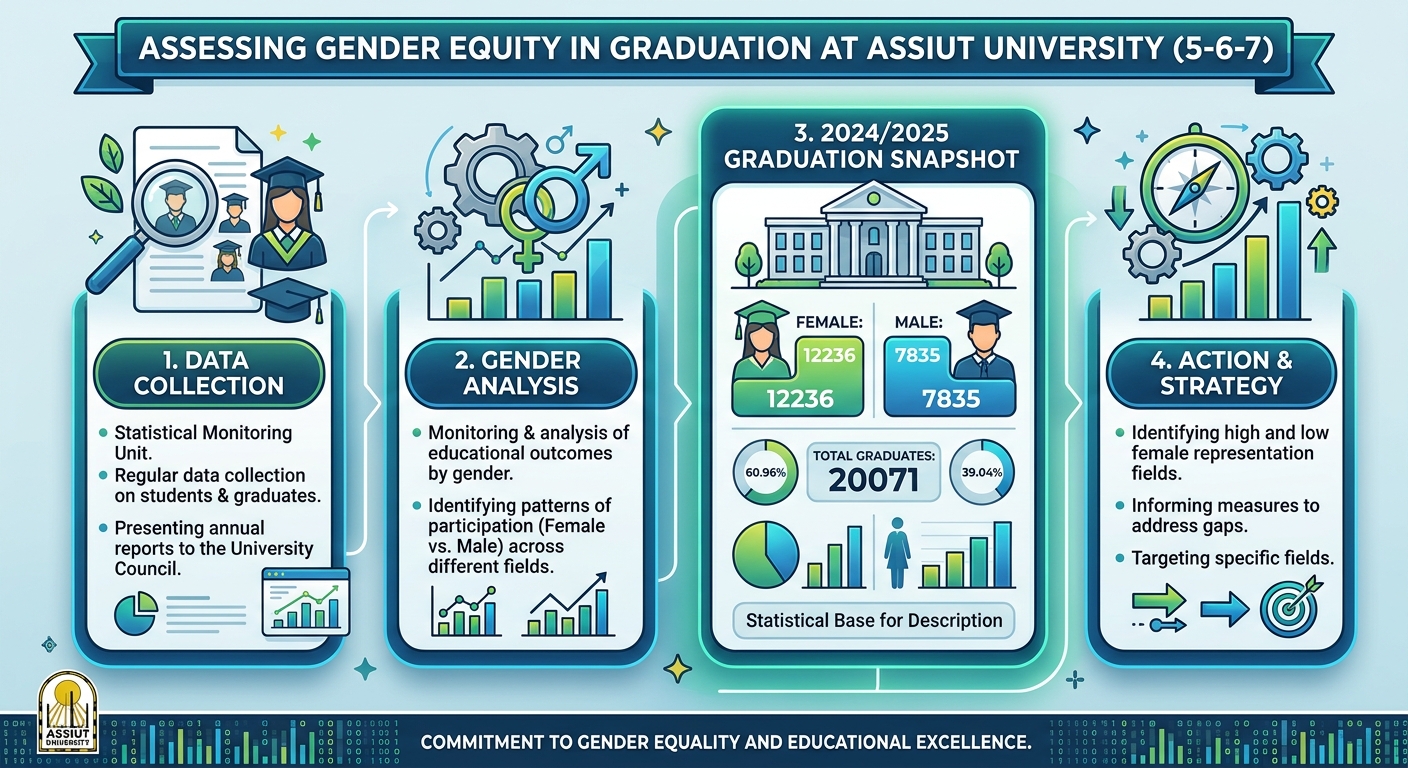
 Measuring and monitoring women’s likelihood of graduating compared with men, and taking measures to address gaps

Assiut University regularly monitors statistical data relating to students and graduates through its Statistical Monitoring Unit, which collects the data and presents them annually to the University Council.

Assiut University monitors and analyzes educational outcomes by gender to identify patterns of participation among female and male students across different fields. Graduate data for the 2024/2025 academic year show 12236 female graduates and 7835 male graduates, out of a total of 20071 graduates, according to the totals recorded in the available database.
These statistics provide a basis for describing the distribution of graduates by gender and field of specialization and identifying fields in which women’s representation is higher or lower than men’s.

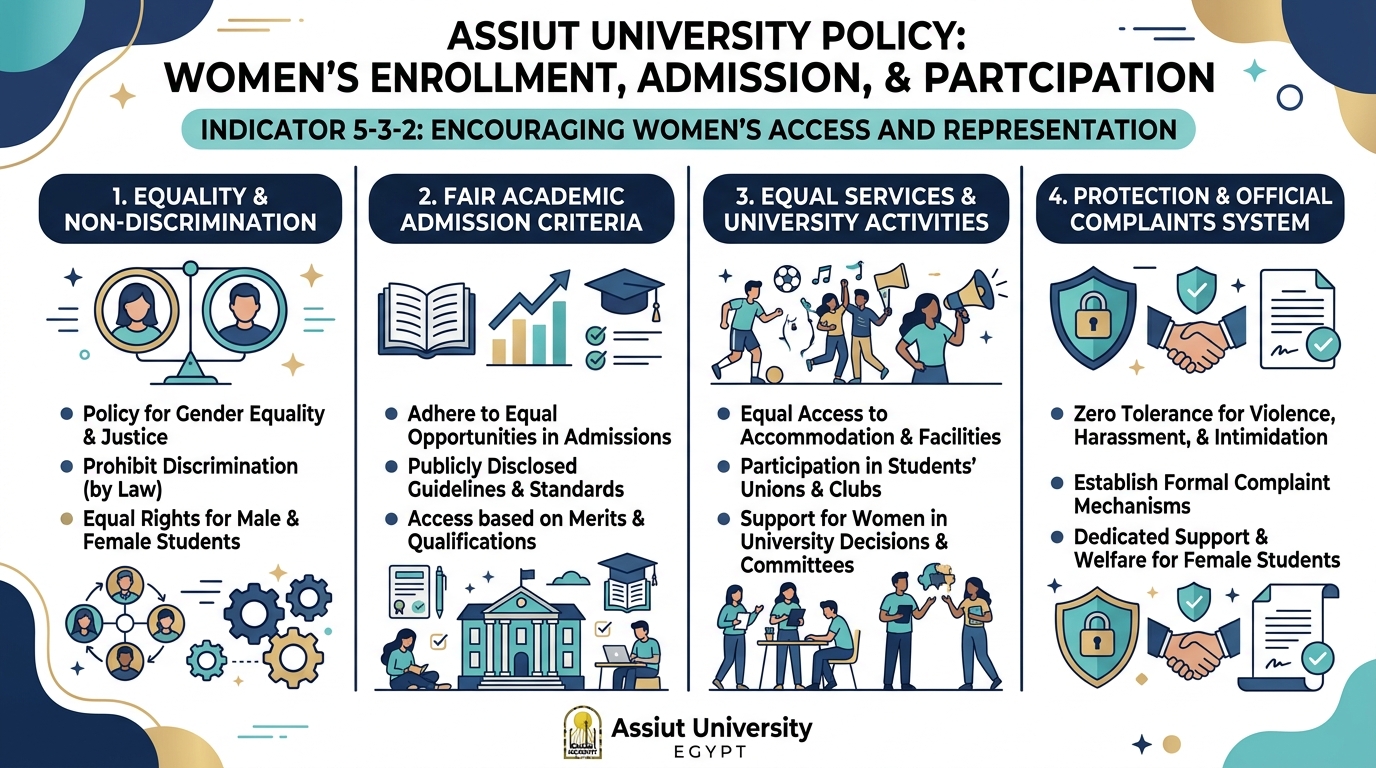
5.3.2 The university policy to addressing women's applications, acceptance/entry, and participation at the university

SDG5
Details:

University policy on women’s enrollment, admission, and participation

Assiut University is committed to promoting equal opportunities in university education and ensuring that female students can apply for admission and enroll in academic programs in accordance with the standards and regulations governing university admission. The University’s published policies reject sex-based discrimination and rely on objective, publicly stated academic criteria for admission, thereby supporting fairness in educational opportunities for male and female students.

The University also supports female students’ participation in university life by providing educational, cultural, and social services and activities within a framework of equality and non-discrimination. These policies provide an institutional framework that supports women’s enrollment in higher education and their participation in various aspects of academic life. They are also supported by a formal complaints and rights-protection system, which promotes fairness in admission procedures and equal opportunities to participate in university life.

The University’s policy on student admission, rights, and non-discrimination includes the following provisions:

Equality and equal opportunities in applying for admission: 

The University affirms its full commitment to applying the principles of equality and equal opportunity to all students and prohibiting any form of direct or indirect sex-based discrimination.

Fair admission procedures: The University admits students according to objective, clearly stated, and publicly available academic criteria to ensure fairness and integrity in the admission process.

Equality in services and participation in university activities:

 The University guarantees all students the right to educational services without discrimination and is committed to providing an educational environment that ensures equal opportunities and participation in cultural, sports, and social activities.

Protection from discrimination and access to a complaints mechanism: 

The policy provides for an official complaints system through which students can report discrimination or violations of their rights, with confidentiality, impartiality, and transparency guaranteed and retaliation against complainants prohibited.

5.3.1 university is systematically measure/track women's application rate and acceptance

SDG5
Details:

Systematic tracking of women’s application, admission, and actual enrollment rates

Assiut University regularly monitors statistical data relating to male and female students through its statistical monitoring system. These data are presented annually to the University Council, enabling the University to track indicators of access to university education, monitor changes over time, and use data to assess admission and enrollment trends. According to the University’s statistical report for the academic year 2024/ 2025 , 13674 women were among the students who began a new 2024/ 2025 academic degree. This practice reflects the University’s commitment to maintaining regular data on women’s participation in higher education, supporting the monitoring of their access to the University and the assessment of related trends.


Related links:

2023 US News Global Ranking

Announce advancement of Assiut University Global Ranking from position 804 to 702.
His excellency professor Elmenshawy congratulated the staff of Assiut University for this great achievement.
Professor Omar Shaaban the Head of the International Ranking office announce the US- news International Ranking is one of the most important ranking that depends on the university publication, citation and academic reputation

14.4.2 - The University's action plan in place to reduce plastic waste on campus

SDG14
Details:

 The University's  action plan in place to reduce plastic waste on campus

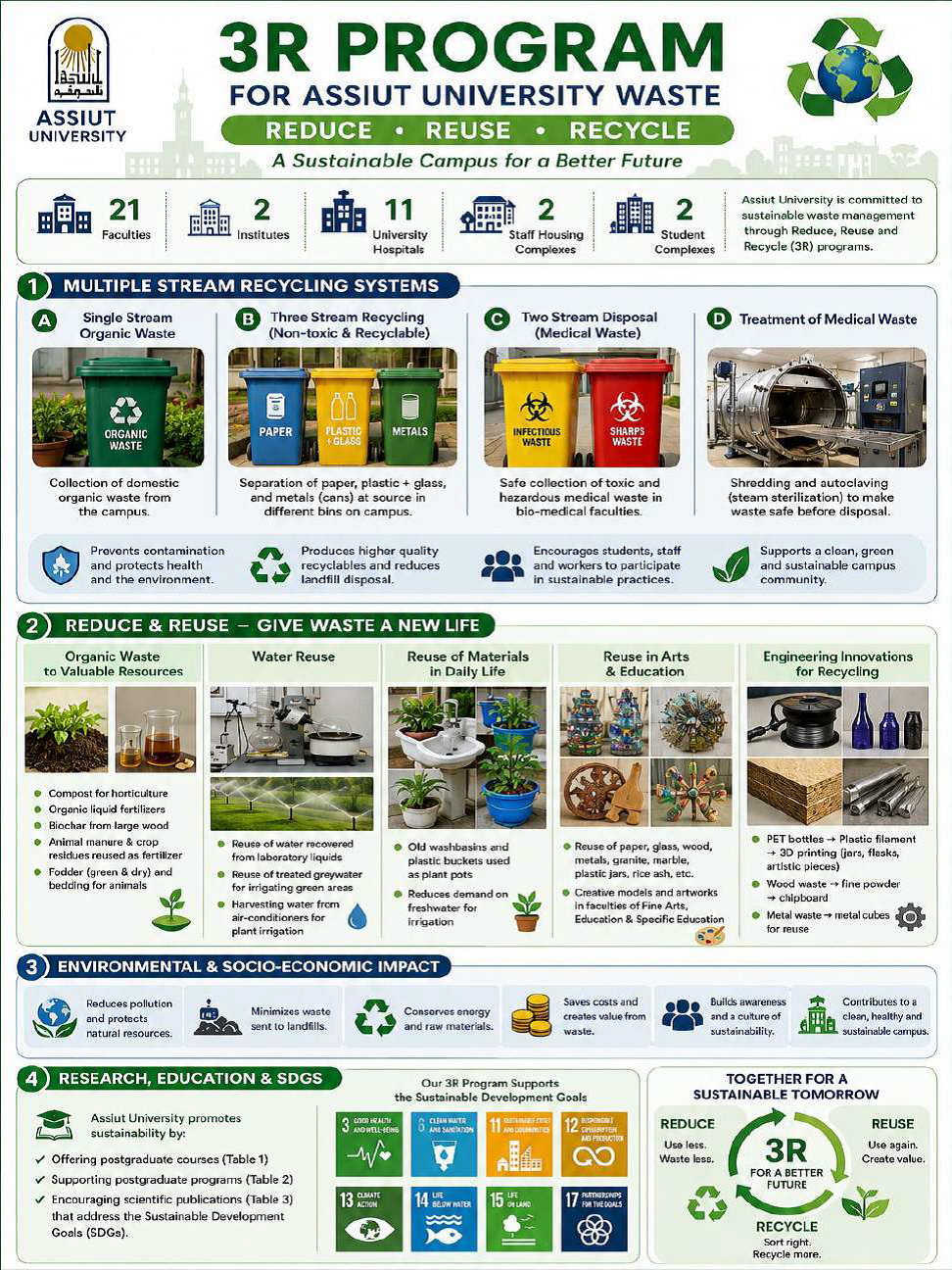
Assiut University has a waste-management programme based on the principles of Reduce, Reuse, and Recycle (3R), supported by multiple-stream recycling systems across the campus. Dedicated recycling bins are provided for separating plastics and other recyclable materials. The University also implements practical plastic-recycling and reuse initiatives. For example, the Faculty of Engineering recycles used PET plastic bottles into plastic filament for 3D printing, while other faculties reuse plastic containers in educational, artistic, and landscaping activities. These measures contribute to reducing plastic waste, promoting resource efficiency, and supporting the University's environmental sustainability objectives.


14.3.3 -The University's work directly (research and/or engagement with industries) to maintain and extend existing ecosystems and their biodiversity, of both plants and animals, especially ecosystems under threat

SDG14
Details:

Assiut University conducts research and external engagement relevant to maintaining and extending ecosystems and biodiversity, including activities addressing the Nile River, freshwater ecosystems, plant diversity, agricultural ecosystems, and invasive or destructive pest species.

https://aun.edu.eg/main/index.php/assiut-university-organizes-awareness-seminar-protecting-nile-river-and-promoting-sustainability

The following some activities to protect ecosystems and contribute through research, environmental management, and awareness.

  1. Specific projects and initiatives:

  2. Nile River cleanup and community environmental partnership 9–10 April 2025 · Partners: Assiut University, CEMEX (Assiut Cement Company), and the Ferry Nile environmental initiative.

    The university organized an awareness seminar on protecting the Nile and supporting local communities, followed by a cleanup campaign in Bosra village, Al-Fath district, Assiut Governorate. Approximately 40 students participated in removing plastic and solid waste from the river environment. The Ferry Nile initiative also works with fishermen to collect and recycle waste, connecting pollution prevention with local livelihoods. The university reported this activity on 9 and 10 April 2025

    https://aun.edu.eg/main/index.php/assiut-university-organizes-awareness-seminar-protecting-nile-river-and-promoting-sustainability

    https://aun.edu.eg/main/index.php/assiut-university-students-participate-campaign-clean-nile-river-bosra-village

2. Campus and off-campus plant diversity and green spaces

Assiut University, including its Faculty of Agriculture and university farms, contributing to the maintenance of plant diversity and green infrastructure:

An arboretum in the University Park campus.

An ornamental-plant farm covering approximately four acres.

An extension farm in Assiut Valley used for undergraduate training and faculty research, with an area of approximately 20 acres and a range of plant and animal resources.

These facilities provide a basis for plant cultivation, agricultural experimentation, education, and maintaining campus green spaces. They support ecosystem-related objectives, although the documentation does not establish that all these facilities are designated natural habitats or threatened-species conservation sites.


3. Research and management of destructive agricultural pests

Our university conducts extensive research on local ecosystems, focusing on the conservation of threatened species and the renovation of degraded habitats. For example, the Faculties collaborates with local environmental agencies to study and maintain ecosystems and their biodiversity native plant species that are at risk of extinction.

  1. Oxidative degradation of sulfafurazole drug by chromium trioxide in diferent acidic media: a kinetic and mechanistic study for treating human diseases, they became harmful to the ecosystem if they reach to the environment. Due to … or degradation of antibiotics to save the humans and ecosystem. 2023 

    https://link.springer.com/article/10.1007/s43994-023-00035-8

  2. Effect of Manure and Compost on the Phytostabilization Potential of Heavy Metals by the Halophytic Plant Wavy-Leaved Saltbush

    https://www.mdpi.com/2223-7747/10/10/2176

  3. Responses of Marine Fungi to Heavy Metal Contamination. 2023

    https://link.springer.com/chapter/10.1007/978-981-99-5022-5_11

  4. Assessment of Ecological and Health Risks of Potentially Toxic Elements in Soil and Plant Under Long-Term Sewage Wastewater Irrigation

    https://pubmed.ncbi.nlm.nih.gov/39394338/

4. Environmental development strategy, 2024–2029

The university announced a 2024–2029 strategic plan emphasizing ecosystem protection, environmental problem-solving, sustainable use of natural resources, international environmental cooperation, and directing scientific research toward sustainable development.

This provides an institutional framework for research and engagement activities, rather than evidence of one specific biodiversity-restoration project.

https://www.aun.edu.eg/main/ar/ryys-jamt-asywt-ystrd-astratyjyt-jamt-asywt-2024-2029-lttwyr-qta-khdmt-almjtm-wtnmyt-albyyt-wthqyq


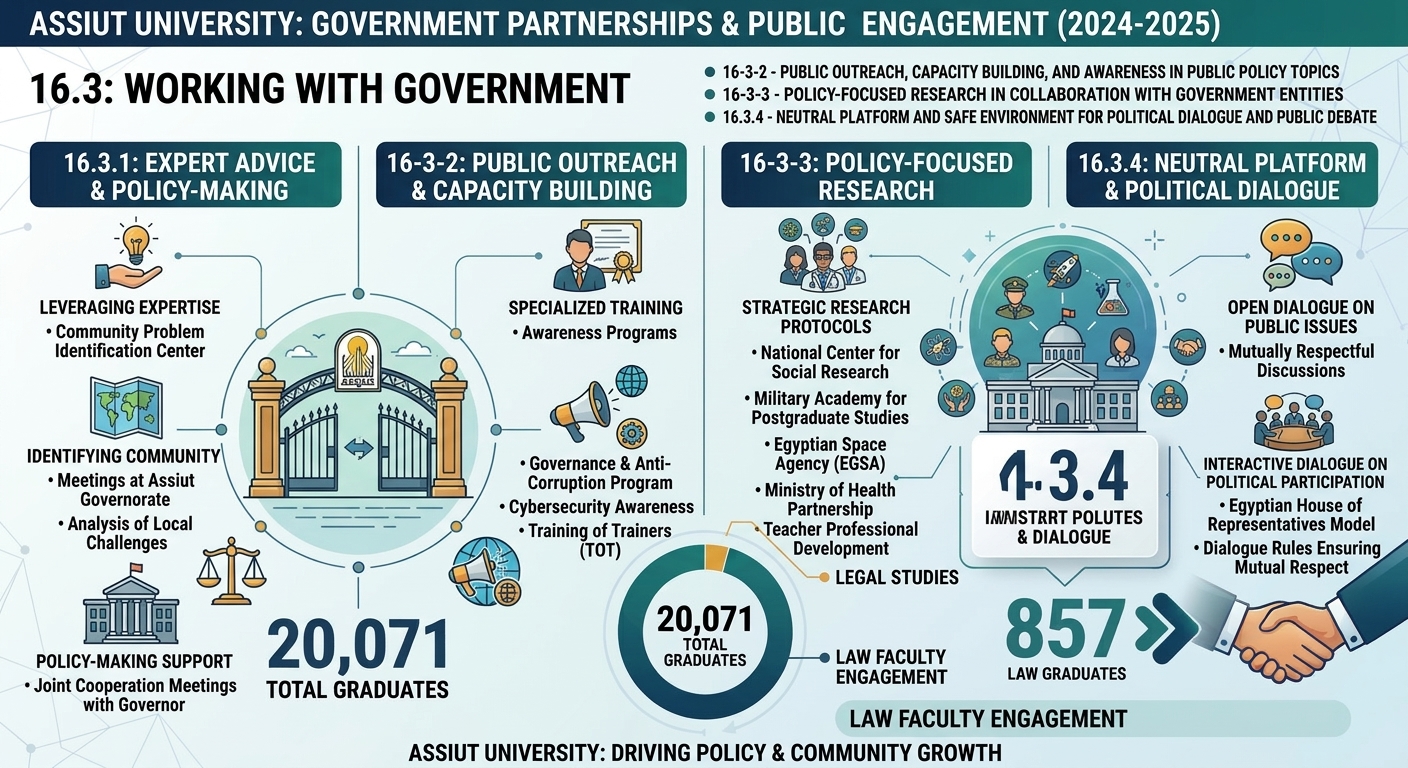
16.3.4 -The University's neutral platform and "safe" space for different political stakeholders to come together to frankly discuss challenges

SDG16
Details:

Neutral Platform and Safe Environment for Political Dialogue and Public Debate

Assiut University fosters an inclusive academic environment for open political dialogue and debate on public issues:

December 2024: 

Faculty of Arts panel discussion titled 'Human Rights between Concept and Application', featuring religious, intellectual, and media leaders.

February 2025: 

Interactive dialogue on political participation organized in cooperation with the Ministry of Youth and Sports, benefiting 100 male and female students.

July 2024: 

Closing session of the Egyptian House of Representatives Model Simulation, engaging students with parliamentary experts and representatives.

Clear dialogue rules ensuring mutual respect, equal expression opportunities, and non-exclusion.

16.3.3 -The University's undertake policy-focused research in collaboration with government departments

SDG16
Details:

 Policy-Focused Research in Collaboration with Government Entities

Assiut University actively conducts policy-oriented research in partnership with national institutions through strategic protocols signed during 2024/2025:

January 15, 2025:

 Protocol with the National Center for Social and Criminological Research for joint research addressing priority societal issues.

March 2025: 

Cooperation protocol with the Military Academy for Postgraduate and Strategic Studies to conduct joint studies on national security and strategic affairs.

April 2025:

 Three agreements with the Egyptian Space Agency (EGSA) to support research in space technology, remote sensing applications, and sustainable development goals.

Ministry of Health Partnership: 

Ongoing joint cooperation protocol between the Faculty of Medicine and the Assiut Health Directorate to enhance healthcare delivery.

November 2024:

 Agreement between the Faculty of Early Childhood Education and the Egyptian-Japanese Schools Sector in Assiut for teacher professional development.

16.3.2 -The University's provide outreach, general education, upskilling and capacity-building to policy- and law-makers on relevant topics

SDG16
Details:

Public Outreach, Capacity Building, and Awareness in Public Policy Topics

The university supports capacity building and public awareness across policy-related fields through specialized training and awareness programs conducted in 2024/2025:

Governance and Anti-Corruption Training Program (April 2025): In collaboration with the National Anti-Corruption Academy and the Administrative Control Authority.

Cybersecurity Awareness Seminar (February 2025): In cooperation with the National Telecom Regulatory Authority (NTRA) and the Ministry of Communications and Information Technology.

Training of Trainers (TOT) Program (May 2025): Held at the Faculty and Leadership Development Center in collaboration with the Supreme Council of Universities.


Subscribe to