

Design, synthesis, and antiproliferative activity of novel thiazole-based derivatives as tubulin polymerization inhibitors targeting the colchicine binding site

Research Abstract

The development of novel microtubule-targeting medicines (MTAs) remains a crucial strategy in cancer treatment, as they combat drug resistance and systemic toxicity. A novel series of thiazole-based derivatives was synthesized, characterized, and evaluated as antitubulin agents endowed with antiproliferative action. An IC50 experiment was performed to assess the efficacy of novel compounds 9a–o in suppressing tubulin activity. The antiproliferative effects of the most potent compounds were evaluated. The levels of initiator caspases (Caspase-8 and Caspase-9) and executioner caspase (Caspase-3) were examined to ascertain the degree of apoptosis. Additionally, the expression levels of the mitochondrial regulatory proteins Bax and Bcl-2 were examined to ascertain the importance of the intrinsic apoptotic pathway. Compound 9k exhibited significant inhibition of tubulin with an IC50 of 1.56 mM and showed potent activity against HeLa (cervical), HCT-116 (colorectal), and A-549 (lung) cancer cell lines. The apoptotic assays revealed that 9k effectively triggered the apoptotic cascade, leading to a ninefold increase in Caspase-3 and a significant twenty-onefold rise in Caspase-9, surpassing the effects of the reference Staurosporine. Caspase-8 was activated by an elevenfold increase, primarily via the intrinsic pathway. This was confirmed by a substantial change in the mitochondrial “rheostat”: 9k induced a 38-fold increase in pro-apoptotic Bax and a 5-fold decrease in anti-apoptotic Bcl-2. Molecular docking studies showed that 9k exhibited a favorable binding mode consistent with its tubulin-inhibition profile. In silico ADMET predictions further supported 9k as a drug-like lead with acceptable oral exposure and a beneficial P-gp–related transporter profile. The enhanced apoptotic effects of 9k compared with Staurosporine make 9k an attractive lead candidate for further development as an anti-cancer drug targeting the colchicine-binding site.
Research Authors
Lamya H. Al-Wahaibi, Ali M. Elshamsy, Taha F. S. Ali, Bahaa G. M. Youssif, Stefan Bräse, Mohamed Abdel-Aziz and Nawal A. El-Koussi
Research Date
Research Journal
RSC Advances
Research Pages
13
Research Publisher
The Royal Society of Chemistry
Research Year
2026

Development of a novel series of thiazole-based compounds with enhanced antiproliferative properties as tubulin polymerization inhibitors

Research Abstract

Introduction: In cancer therapy, inhibiting tubulin polymerization is a key approach for modifying microtubule dynamics required for cell survival and proliferation. Microtubule destabilizing agents (MDAs), also known as tubulin polymerization inhibitors, prevent tubulin heterodimers from forming microtubules, resulting in catastrophic cellular collapse. Methods:A novel series of thiazole-based compounds 8a-o was developed to inhibit tubulin polymerization and assess for its antiproliferative efficacy against the NCI 60 cell line. The structures of the newly synthesized compounds were confirmed using 1H NMR, 13C NMR, and elemental microanalyses. All 15 compounds (8a-o) were assessed for antiproliferative action at a single dosage (10 µM) and analyzed against the comprehensive 60-cell panel at five concentrations (0.01, 0.1, 1, 10, and 100 µM). Results and Discussion:The results from the one-dose and five-dose studies demonstrate that 8b, 8c, 8d, 8m, and 8o are the most prominent antiproliferative agents, exhibiting the most favourable low-micromolar GI50 values across various cell lines, frequently advancing to low-micromolar TGI, and, in numerous sensitive cell lines, achieving LC50 values within the single-digit micromolar range. Compounds 8b, 8d and 8m showed significant anti-tubulin activity, with IC50 values ranging from 3.86 to 7.19 µM, compared to the reference CA-4 (IC50 = 2.40 µM). In the MCF-7 breast cancer cell line, compound 8m drove a significant accumulation of cells in the G2/M phase, increasing from 13.74% to 45.35%. G2/M arrest is frequently associated with DNA damage or the inhibition of microtubule dynamics, which aligns with Western blot results demonstrating a decrease in tubulin (50 kDa) expression following treatment with 8m. Apoptotic and necrotic experiments indicate that 8m stimulates a defined programmed cell death pathway rather than inducing non-specific toxic necrosis. Molecular docking corroborated their binding at the colchicine site, while in silico ADMET profiling indicated a promising drug-like profile for compound 8m

Research Authors
Lamya H. Al-Wahaibi, Ali M. Elshamsy, Taha F. S. Ali, Bahaa G. M. Youssif, Stefan Bräse, Mohamed Abdel-Azizand Nawal A. El-Koussi
Research Date
Research Journal
Frontiers in Chemistry
Research Pages
21
Research Year
2026

Meeting of the Department of Pharmaceutical Chemistry Council, Faculty of Pharmacy, will be held on Wednesday, October 7, 2026.

God willing, the 503st meeting of the Department of Pharmaceutical Chemistry Council at the Faculty of Pharmacy will be held on Wednesday, October 7, 2026., at 10:00 AM in the department library.

news category
خبر عام

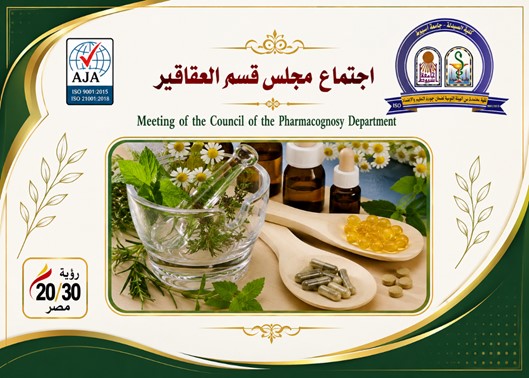
Meeting of the Council of the Department of Pharmaceutical Analytical Chemistry on Wednesday, October 7, 2026.

God willing, the 544st Meeting of the Council of the Department of Pharmaceutical Analytical Chemistry at the Faculty of Pharmacy will be held on Wednesday, October 7, 2026., at 11:00 A.M 

in the Department Council Meeting Hall.

news category
خبر عام

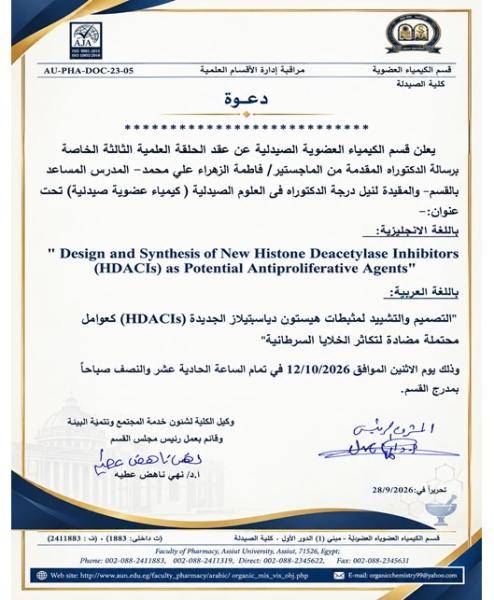
Invitation to attend the 3rd Scientific Seminar in the Department of Pharmaceutical Organic Chemistry on: " Design and Synthesis of New Histone Deacetylase Inhibitors (HDACIs) as Potential Antiproliferative Agents "

The Department of Pharmaceutical Organic Chemistry announces the holding of the 3rd Scientific Seminar for the Ph.D. thesis submitted by Ms. Fatma Elzahraa Ali Mohamed, Assistant Lecturer at the department, enrolled to obtain a Ph.D. degree in Pharmaceutical Sciences (Pharmaceutical Organic Chemistry) 

under the title:

"Design and Synthesis of New Histone Deacetylase Inhibitors (HDACIs) as Potential Antiproliferative Agents"

This will take place on Monday, October 12, 2026, at 11:30 AM at the department's auditorium. 

news category
قسم الكيمياء العضوية

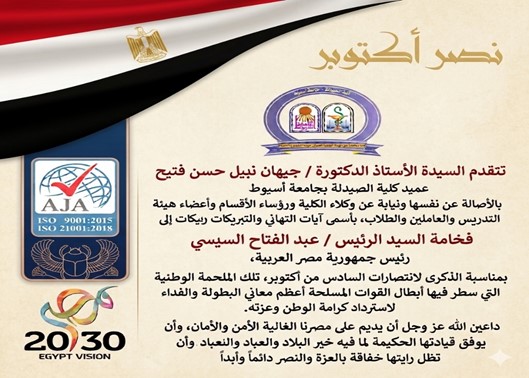
The Dean of the Faculty of Pharmacy congratulates everyone on the anniversary of the October 6th victories. Wishing Egypt Continued Prosperity and Peace.,,,

Professor Gihan Nabil Hassan Fetih, Dean of the Faculty of Pharmacy, Assiut University,
on behalf of herself and on behalf of the vice deans, heads of departments, academic staff, employees, and students,
extends her warmest congratulations and best wishes to

His Excellency President Abdel Fattah El-Sisi,
President of the Arab Republic of Egypt,

on the occasion of the glorious  anniversary of the October 6th Victories—that historic national epic in which the heroes of the Egyptian Armed Forces demonstrated the highest meanings of courage and sacrifice to restore the nation’s dignity and pride.

We prays to Almighty God to preserve Egypt’s security and stability,
to grant success to its wise leadership in all that serves the good of the nation and its people,
and to keep Egypt’s flag forever raised high with glory and victory.


news category
خبر عام

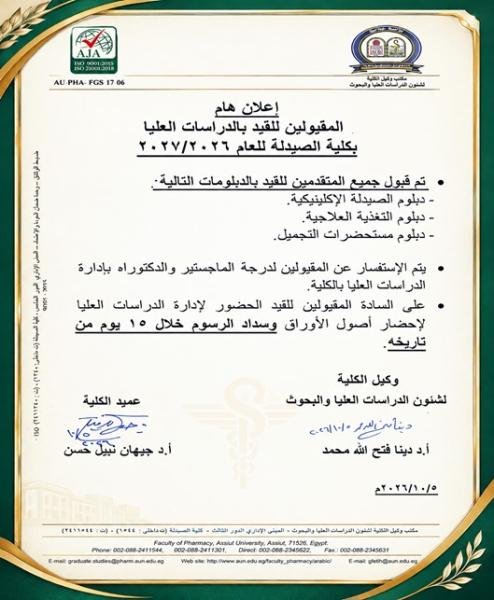
Important announcement for those accepted into postgraduate studies at the College of Pharmacy for the academic year 2026/2027.


• All applicants have been accepted for the following diplomas:


• Diploma in Clinical Pharmacy

• Diploma in Therapeutic Nutrition

• Diploma in Cosmetics

• Inquiries regarding admission to Master's and Doctoral programs should be directed to the College's Graduate Studies Department.

• Those accepted for admission must visit the Graduate Studies Department within 15 days of this date to submit original documents and pay the fees.

news category
إعلانات الدراسات العليا
Subscribe to