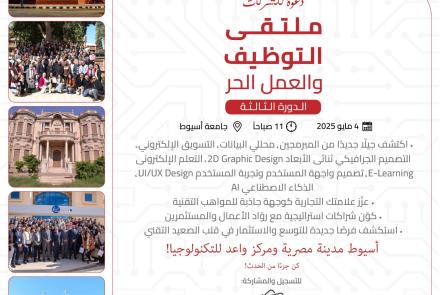
the activities of the employment and self-employment forum
1

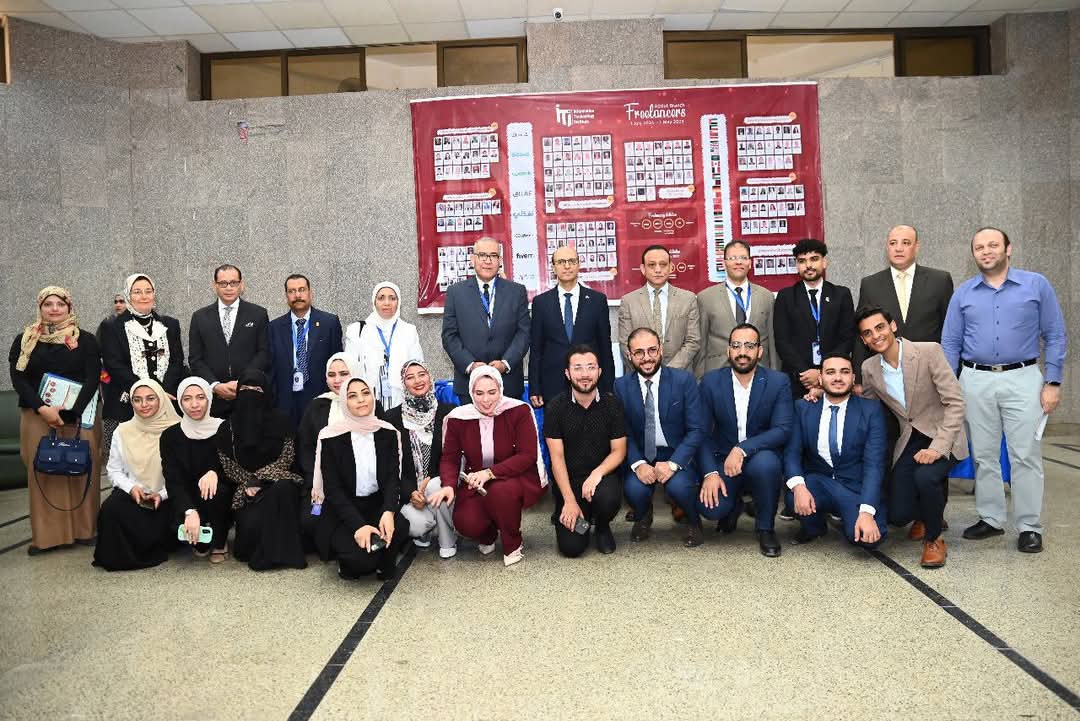
The president of Assiut University opens the exhibition of graduation projects of students of the Faculty of computers and information and ITI institute within the activities of the employment and self-employment forum
- Dr. El-Minshawy praises the innovations of computer students and"ITI" in artificial intelligence and modern technological applications

- President of Assiut University: graduation projects reflect the skills of our students in employing٠ technology to serve various scientific and knowledge fields

Dr. Ahmed El-Minshawy, president of Assiut University, opened on Sunday, May 4, the exhibition of graduation projects for final-year students at the Faculty of computers and Information Technology, and students of the Information Technology Institute in Assiut ITI, which was organized by the Faculty of computers and information as part of the activities of the "employment and self-employment forum" in its third edition, in cooperation with the branch of the Information Technology Institute in Assiut.

The president of the university was accompanied on his tour during the exhibition by: Dr. Jamal Badr, vice president for graduate studies and research, Dr. Tayseer Hassan Abdul Hamid, dean of the Faculty of computers and Information, Dr. Khaled Fathy, vice dean for education and Student Affairs, Engineer Ayman Ayad, director of the Institute branch in Assiut, and Mr. Ihab Abdul Hamid, director of the medium, small and Micro Enterprise Development Authority, with the participation of a number of faculty members, students, and a number of developers and technicians from various technological companies.

During the opening ceremony, Dr. El-Minshawy expressed his appreciation and admiration for the creative and innovative scientific production provided by the students through their projects, which reflected the level of development and outstanding training enjoyed by the University's students and graduates, calling on them to continue to develop their ideas, seek to apply them and compete regionally and globally.

Dr. El-Minshawy stressed that Assiut University is constantly keen on qualifying promising university youth to keep up with the requirements of the labor market and the latest technology, praising the unlimited creativity of its students and the ability to keep up with the latest technological and technical education in various fields of science.

During his tour of the exhibition, the president of the University praised the extent to which students were able to explore and apply artificial intelligence technologies in their ideas and projects, which keeps pace with the strengthening of the University's management of all modern applied and technological fields in various sectors, wishing them a bright future and continuous success in all fields of technology and its applications.

The projects of the students of the Faculty of computers and information included a lot of creative ideas, which numbered (16) a project, during which the students relied on employing the latest artificial intelligence applications and technologies in various scientific fields and knowledge, including; applications and websites for educational games, Smart networks, electronic exam monitoring systems, a website to facilitate learning, a surveillance camera equipped with the latest technologies, as well as a mobile application to find lost items, and another application for recipes and diets.

The projects also included the "Rahala" platform, which is an integrated tourism platform on the web and mobile, the "Nabta" application in the agricultural field, as well as a desktop application with a computer to measure glycines and diagnose diseases, the "business" website for data analysis, a mobile application to identify skin diseases, burns and necessary first aid, a digital website for managing the fleet of Assiut University cars, in addition to a medical mobile website and application to identify the nearest pharmacy and doctors ' consultant, as well as a smart watch that determines the health status of the child according to his health history.

As for the projects of ITI students, they were participated by 10 students, submitted about 400 an idea and an innovative project that they worked on and implemented during their years of study in the fields of; Free Lance freelance jobs, website building and design, open source applications, digital marketing, and website development.
the "employment and self-employment forum

1

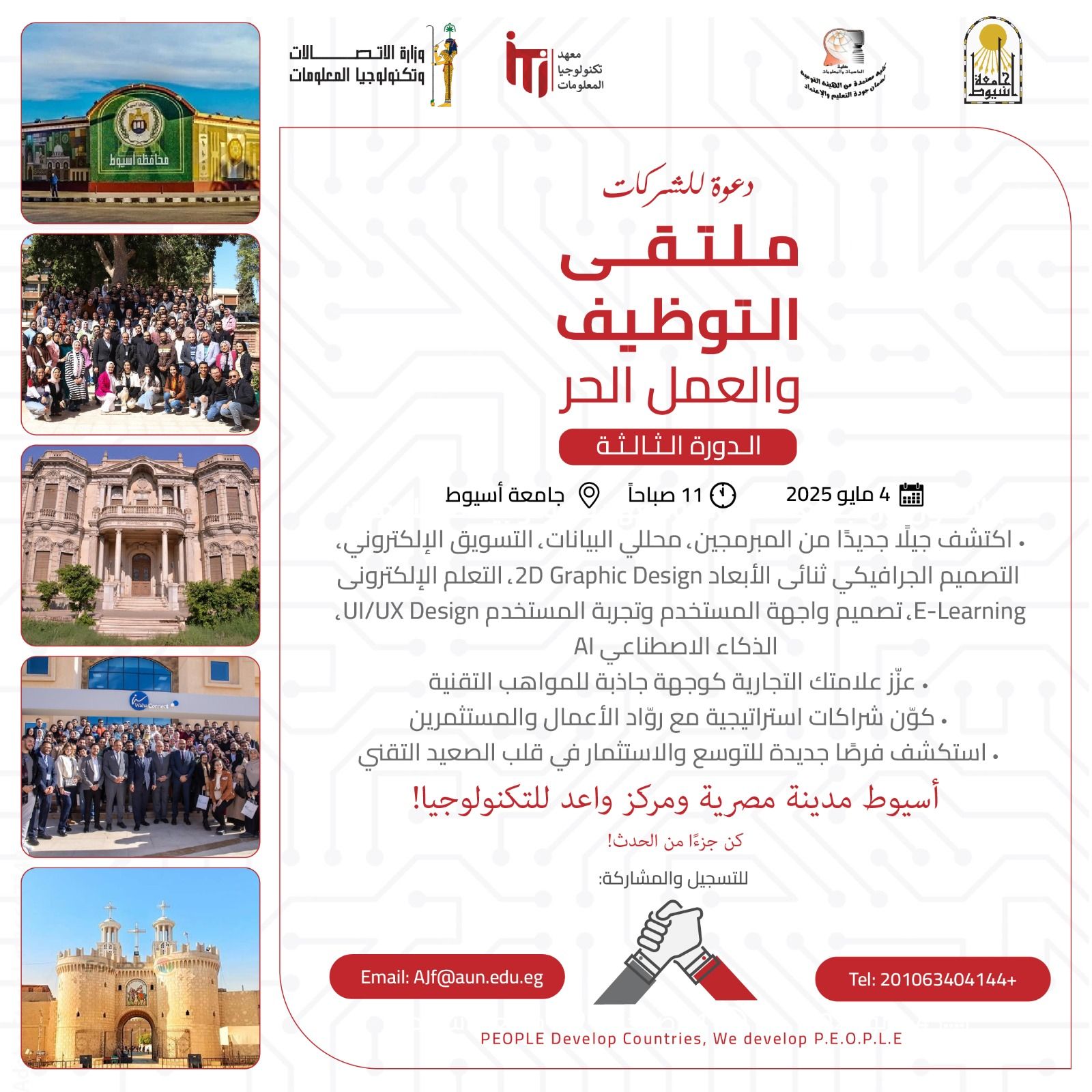
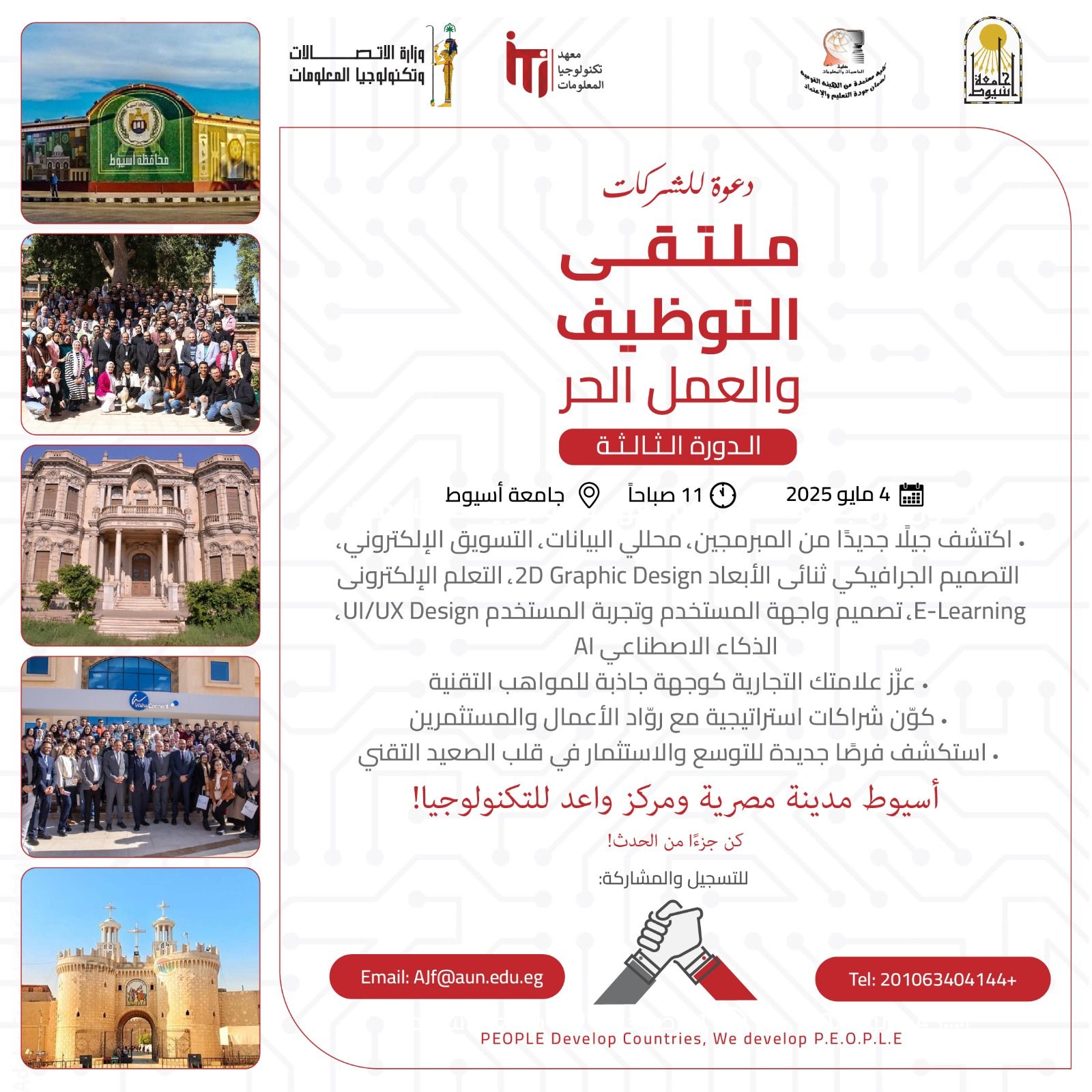
The Faculty of Computers and Information at Assiut University launches the activities of the third edition of the

"employment and self-employment" forum with the wide participation of major technology companies

Assiut University witnessed, on Sunday, May 4, 2025, the launch of the activities of the third session of the "employment and self-employment forum", which was organized by the Faculty of Computers and Information in cooperation with the branch of the Institute of Information Technology in Assiut, affiliated with the Ministry of Communications and Information Technology, under the supervision of Dr. Ahmed El-Minshawy, university president, and the supervision of Dr. Ahmed Abdul-Mawla, vice president of the University for Education and Student Affairs, Dr. Heba Saleh, president of the Institute of Information Technology, and Dr. Tayseer Hassan Abdul Hamid, dean of the College of computers and information.

The events were attended by Dr. Mahmoud Abdul Alim, vice president of the University for Community Service and Environmental Development, Dr. Jamal Badr, vice president of the University for Graduate Studies and Research, along with several faculty members, a selection of experts, developers, and specialists in the fields of technology, and representatives of 22 local and international companies operating in the sector, which provided more than 250 job opportunities and training for university graduates.

The forum was held under the supervision of Professor Dr. Khaled Fathi Abdul Aziz, vice dean of the Faculty of Computers and Information for Education and Student Affairs, and engineer Ayman Ayad, director of the branch of the Institute of Information Technology in Assiut.

 Dr. Ahmed El-Minshawy stressed that the forum is an important interactive platform that enables students and graduates to communicate directly with employment institutions and learn about the realistic requirements of the labor market in various fields of modern technology, including artificial intelligence, cybersecurity, data analysis, and digitization. He explained that the University seeks to support the culture of self-employment, promote entrepreneurship thought in line with national trends of digital transformation, and empower young people in the fields of advanced technology.

For his side, Prof. Dr. Mahmoud Abdel Alim explained that the forum embodies the University's vision of preparing qualified cadres capable of competing in the labor market, and reflects the efforts of the Ministry of Higher Education and scientific research in strengthening the link between academic institutions and the labor market and providing real opportunities for Egyptian youth.

Dr. Jamal Badr toured the exhibition of companies participating in the forum, which included 22 technological companies, that provided more than 250 job opportunities and training for university graduates, praising the level of fruitful cooperation between the University and those companies, reflecting the business community's confidence in the quality of Education outputs at the University.

 Dr. Tayseer Hassan Abdul Hamid expressed her pride in the students of the Faculty of Computers and Information, stressing that they represent the most prominent beneficiaries of this type of partnership, because of their efficiency and excellence, which enabled them to prove themselves in major international institutions, wishing them further success and progress.

Dr. Khalid Fathi Abdul Aziz pointed out that the forum is a golden opportunity to develop students ' technical and professional skills and enhance their ability to actively engage in the labor market through interaction with leading technology companies.

In his speech, engineer Ayman Ayad conveyed the greetings of Dr. Heba Saleh, president of the Institute of Information Technology, to the administration of Assiut University, praising the partnership that began since 2007 when the University hosted the headquarters of the Institute, which started with only 100 trainees, and today reached more than 5,000 training grants annually, stressing that the institute is not limited in its support on the technological side, but is keen to develop comprehensive skills qualified for the labor market.

Engineer Hossam Megahed, chairman of the board of Directors of the association "Elites NGO", stressed that the ICT sector in Egypt is facing a challenge represented by the lack of qualified cadres, in exchange for the availability of a large number of young people looking for job opportunities, stressing that the best solution is to develop technological skills for young people, especially in Upper Egypt governorates, through effective partnerships such as cooperation between Assiut University and the Institute of Information Technology.

The opening of the forum witnessed the presentation of a documentary film highlighting the aspects of cooperation between the Institute of Information Technology and the College of Computers and Information, a review of the most important activities of the Institute and its services provided to students, as well as a video of a number of graduates of the college and the Institute who joined the labor market in major companies.

The forum included a series of lectures and dialogue sessions, presented by several representatives of local and international companies, including: "From Education to Employment: Building Bridges of Success" by engineer Hossam Megahed, "digital generations of Egypt: empowering youth to shape the future" by Dr. Firouz Mahmoud, Director of training at the Ministry of Communications and Information Technology," success story" by Dr. Hussein Ibrahim, Microsoft," programming at the speed of thinking" by Dr. Mohamed Beltagi, Optomotica, and"beyond coding" by engineer Nada Ehab, from gabi, and"remote work ethics" by Engineer Ahmed Ayman, from turn digital, and"data technologies and products" by engineer Mohamed Abdo, from spaceman, and"post-graduation" by engineer Hani Abdul Wahab, and"financial technology" by engineer Andrew saber, from Petra, and"the story of the establishment of clinical platform for booking medical services" by engineer Haitham Essam

This forum comes within the framework of Assiut University's efforts to enhance employment opportunities and digital entrepreneurship and support the capabilities of its students and graduates to qualify them for strong competition in the local and international labor markets.

news category
Jobs

Relation extraction from arabic wikipedia

Research Abstract

Objectives/Methods

This study aims to extract relations between entities from Arabic text. RelationExtraction is one of the most important tasks in text mining. Relation extraction is considered as a main step for many applications such as extracting triples from the text, Question Answering and Ontology building. However, extracting relations from the Arabic text is a difficult task compared to English due to lack of annotated Arabic corpora. This paper proposes a method for extracting relations from Arabic text based on ArabicWikipedia articles characteristics. The propose system extracts sentences that contain principle entity, secondary entity and relation from Wikipedia article, then we use WordNet and DBpedia to build the training set. Finally Naive Bayes Classifier is used to train and test the datasets.

Finding

There are few works to extract relations from Arabic text. These works depend on classification, clustering and rule based.

Application/improvement

The experiments show the effectiveness of the proposed approach which achieves high precision with 89% for classifying 19 type of semantic relations.

Research Authors
Gehad Zakria, Mamdouh Farouk, Khaled Fathy, Malak N Makar
Research Date
Research Department
Research Journal
Indian Journal of Science and Technology
Research Member
Research Pages
01-06
Research Vol
Volume 12, Issue 46
Research Website
https://scholar.google.com/scholar?oi=bibs&cluster=16981496231598000900&btnI=1&hl=en
Research Year
2019

Semantic Representation Extraction from Unstructured Arabic Text

Research Abstract

One of the crucial tasks in the Semantic Web research is extracting information from unstructured text and converting it into semantic form to be machine understandable. This semantic representation is useful for many purposes such as question answering, summarization and information retrieval. This paper provides a system for converting Arabic text into Resource Description Framework (RDF) semantic format. The proposed system includes syntactical parser that used to extract triples (subject-predicate-object) from preprocessed Arabic text. Moreover, name entity recognition is used to extract entities which mapped with DBpedia to get URIs. Finally, the corresponding RDF representation which captures semantics of Arabic text is generated.

Research Authors
Gehad Zakria, Mamdouh Farouk, Khaled Fathy, Malak N Makar
Research Date
Research Department
Research Journal
Proceedings of the 8th International Conference on Software and Information Engineering
Research Member
Research Pages
222-226
Research Website
https://dl.acm.org/doi/abs/10.1145/3328833.3328875
Research Year
2019

Light Field Reconstruction With Dual Features Extraction and Macro-Pixel Upsampling

Research Abstract

Dense multi-view image reconstruction has been a focal point of research for an extended period, with recent surges in interest. The utilization of multi-view images offers solutions to numerous challenges and amplifies the effectiveness of various applications including 3D reconstruction, de-occlusion, depth sensing, saliency detection, and identifying salient objects. This paper introduces an approach to reconstructing high-density light field (LF) images, addressing the inherent challenge of balancing angular and spatial resolution caused by limited sensor resolution. We introduce an innovative approach to reconstructing LF images through a CNN-based network that combines spatial and epipolar features in both initial and deep feature extraction phases. Our network utilizes angular information during upsampling and employs dual feature extraction to effectively analyze horizontal and vertical epipolar data. Weight sharing within the CNN block between horizontal and vertically transposed stacks enhances quality while preserving model compactness. The outcomes of experiments carried out on real-world and synthetic datasets demonstrate the effectiveness of our method, showcasing its superior performance in both inference speed and reconstruction quality when compared to state-of-the-art (SOTA) techniques.

Research Authors
AHMED SALEM , EBRAHEM ELKADY , HATEM IBRAHEM , JAE-WON SUH , AND HYUN-SOO KANG
Research Date
Research Department
Research Journal
IEEE Access
Research Publisher
IEEE
Research Rank
international
Research Year
2024

Reconstructing angular light field by learning spatial features from quadrilateral epipolar geometry

Research Abstract

Recent research on dense multi-view image reconstruction has attracted considerable attention, due to its enhancement of applications such as 3D reconstruction, de-occlusion, depth sensing, saliency detection, and prominent object identification. This paper introduces a method for reconstructing high-density light field images, addressing the challenge of balancing angular and spatial resolution within the constraints of sensor resolution. We propose a three-stage network architecture for LF reconstruction that processes dense epipolar, spatial, and angular information efficiently. Our network processes epipolar information in the first stage, spatial information in the second stage, and angular information in the third stage. By extracting quadrilateral epipolar features from multiple directions, our model constructs a robust feature hierarchy for accurate reconstruction. We employ weight sharing in the initial stage to …

Research Authors
Ebrahem Elkady, Ahmed Salem, Hyun-Soo Kang, Jae-Won Suh
Research Date
Research Department
Research Journal
Scientific Reports
Research Year
2024
Subscribe to