Congratulations to Professor Dr. Hanan Sayed Farghaly, Professor and Head of the Department of Pharmacology, on the occasion of joining the Egyptian Drug Authority.

Congratulations to Professor Dr. Hanan Sayed Farghaly, Professor and Head of the Department of Pharmacology, on the occasion of joining the Egyptian Drug Authority.

Congratulations to Professor Dr. Hanan Sayed Farghaly, Professor and Head of the Department of Pharmacology, on the occasion of joining the Egyptian Drug Authority.


Identifying Predictors of Early Postoperative Pain and Patient Satisfaction Following Day Surgery: Insights From an Observational Study

Research Authors
Salah N. EL-Tallawy • Abdullah T. Alsubaie • Elsayed A. Yousef • Fahriziya T. Dahum • Tarek A. Abdelzaher • Rania S. Ahmed • Vanessa M. Alcudia • Walid R. Badawy • Sheryll A. De Vera • Mohamed S. Nagiub • Amal R. Aljumah • Essam M. Manaa • Wegdan A. Ali
Research Date
Research Journal
Cureus Journal of Medical Science
Research Member
Research Pages
1-16
Research Publisher
Published via NEMA Research Group. Springer Nature
Research Vol
17
Research Year
2025

Gallic acid counteracts tartrazine-induced testicular dysfunction in rats: biochemical, histopathological and ultrastructural evidences

Research Abstract

Background Tartrazine (Tz) is one of the most commonly used colorants incorporated in the food manufacturing. Its toxicity is derived from metabolic byproducts representing health hazards to consumers. Gallic acid (GA) is known for its redox stabilizing, anti-apoptotic, and cytoprotective characteristics. Therefore, the aim of this study is to explore the possible defensive efect of GA against Tz-induced testicular dysfunction. To achieve this objective, 18 male Wistar adult rats were randomly and equally categorized into three groups for 30 days. The control group received no treatment. Tz at a dose of 30 mg/kg BW was administered to the Tz group. The Tz+GA group received GA at a dose of 200 mg/kg BW in concurrent with the previously described Tz dosage. Both Tz and GA were supplemented orally once daily by a stomach tube. Results The marked decline in luteinizing hormone, follicle stimulating hormone, testosterone, and estradiol 17beta confrmed deviation in pituitary–gonadal axis of Tz-exposed rats. Imbalances in plasma redox equilibrium were evi‑ dent, characterized by a notable increase in malondialdehyde and nitric oxide levels, along with a decrease in reduced glutathione and total antioxidant capacity. Deteriorations in histopathological features, fbrosis in testicular tissue, abnormalities in Sertoli cell, and up-regulation in caspase-3 were observed. Conversely, GA administration successfully reversed these issues. Conclusion The ability of GA to counteract toxicological molecular targets in Tz-exposed testes is believed to be achieved through the restoration of oxidant/antioxidant balance and the prevention of the apoptotic cascade. Keywords Tartrazine, Gallic acid, Testis, Sexual hormones, Redox balance, Apoptosis

Research Authors
Hanan Waly, Rahma F Ezz El-Arab, Nasser S Abou Khalil, Khaled MA Hassanein, M Bassam Al-Salahy, Shaimaa MM Saleh
Research Date
Research Department
Research Journal
The Journal of Basic and Applied Zoology
Research Year
2024

Testicular tissue oxidative stress in azoospermic patients: Effect of cryopreservation

Research Abstract

This study evaluated oxidative stress (OS) in human testicular tissue in obstructive (OA) and nonobstructive azoospermia (NOA) before and after cryopreservation. Azoospermic patients were subjected to surgical sperm retrieval (SSR) and cryopreservation. Assay of catalase activity (CAT) and malondialdehyde level (MDA) using colorimetric methods was done. The number of retrieved spermatozoa and the Johnson score were assessed in fresh testicular samples. The study included 21 OA (group A) and 16 positive sperm retrieval (group B, positive NOA). The basal CAT activity in the positive NOA group was significantly higher than that in the OA group. Basal MDA level was also significantly higher in NOA than in OA group. CAT activity and MDA level correlated negatively with the mean number of retrieved spermatozoa. After cryopreservation, there was a significant increase in CAT activity in OA, while there was no significant difference in MDA level in both OA and positive NOA. We concluded that patients with NOA seem to have increased testicular OS compared to OA. The extent of OS correlated negatively with spermatogenesis grade. Testicular tissue of patients with OA seems to withstand OS induced by cryopreservation more than NOA.

Research Authors
Alaa E Moubasher, Emad A Taha, Aya Younis, Mickel E Fakhry, Hanan Morsy
Research Date
Research Department
Research Journal
Andrologia
Research Website
https://doi.org/10.1111/and.13817
Research Year
2020

Comparative impacts of Saudi Arabian and Egyptian Aspergillus flavus-associated Aflatoxin B1 on rats

Research Abstract

Aflatoxin B1 (AFB1) is a carcinogenic secondary metabolite of filamentous Aspergillus species. This study investigated the effects of Saudi Arabian (local) and Egyptian (imported) Aspergillus flavus-associated AFB1 on rats (hematological parameters, liver, and kidneys). Saudi Arabian and Egyptian A. flavus-associated AFB1 (0.5 mg/kg) were separately fed to two groups of five rats each for 21 days. The control group (5 rats) was fed water and a basal pellet diet for 21 days (a total of 15 rats, 5 rats in each treated group and 5 rats as control). The blood samples from the rats in all the groups were subsequently examined for complete blood count (CBC) data [red blood cell (RBC), neutrophil, and platelet counts; basophil counts; eosinophil, hemoglobin (Hb) content; monocyte, lymphocyte, and mean corpuscular hemoglobin (MCH) counts; mean corpuscular volume (MCV); mean corpuscular hemoglobin concentration (MCHC); and white blood cell (WBC)]. Liver function was assessed by examining the serum levels of alkaline phosphatase (ALP), aspartate aminotransferase (AST), and albumin in all groups. The kidney function test was based on the levels of uric acid, urea, creatinine, and urea. AFB1-induced histopathological changes were observed under a light microscope. One-way ANOVA coupled with Tukey’s LSD test revealed that AFB1 in both isolates (Saudi Arabian and Egyptian) significantly decreased the RBC count, whereas a significant increase in the platelet, WBC, neutrophil, and monocyte counts was noted. Compared with the control treatment, Saudi Arabian AFB1 treatment significantly reduced the MCH and MCHC values. The serum levels of AST, ALP, urea, and creatinine were significantly greater in the Saudi Arabian AFB1-treated group than in the other two groups, whereas the level of ALB was significantly lower in this group than in the Egyptian AFB1-treated group and controls. Histological examination of the liver revealed central vein dilatation and congestion of the portal area with leucocyte infiltration in both AFB1-treated groups, which led to substantial cell mortality. Both AFB1 treatments caused hypertrophied hepatocytes with pyknotic nuclei and granular vacuolated cytoplasm. The AFB1-treated groups presented marked renal damage characterized by cupping of Bowman's capsule, glomerular membrane disruption, and tubular damage. However, adverse effects were more severe in the Saudi Arabian AFB1-treated group. Both AFB1 treatments induced hematological and organ toxicity in rats. However, the toxicity of Saudi Arabian A. flavus-associated AFB1 was more pronounced than that of Egyptian A. flavus-associated AFB1. The findings of the current study may help improve hygiene measures to lower mycotoxin contamination in commercial food products, as well as emphasise the health hazards posed by A. flavus-contaminated household foodstuffs.

Keywords – Aflatoxin B1 – Aspergillus flavus – Hematology – Kidney – Liver – Rats – Toxicity

Research Authors
Ashi H, Hamed EH, Refaat B, Almughamsi HM, Neyaz LA, Alahmadi TFH, Arafa SH, Alami OT, Al-Rahmani F, Alqurashi EH, Alsulami FS, Alzahrani YA, Alamri AA, Abduljawad GH, Alobaidi AA, Malak H, Elbanna K and Abulreesh HH.
Research Date
Research Department
Research Journal
Current Research in Environmental & Applied Mycology
Research Member
Research Pages
356–370
Research Publisher
Current Research in Environmental & Applied Mycology
Research Rank
Q2
Research Vol
14(1)
Research Website
https://www.researchgate.net/profile/Hussein-Abulreesh/publication/387087941_Comparative_impacts_of_Saudi_Arabian_and_Egyptian_Aspergillus_flavus-associated_Aflatoxin_B1_on_rats/links/676b2bd4894c552085283ad4/Comparative-impacts-of-Saudi-Arabian-and-Egypt
Research Year
2024

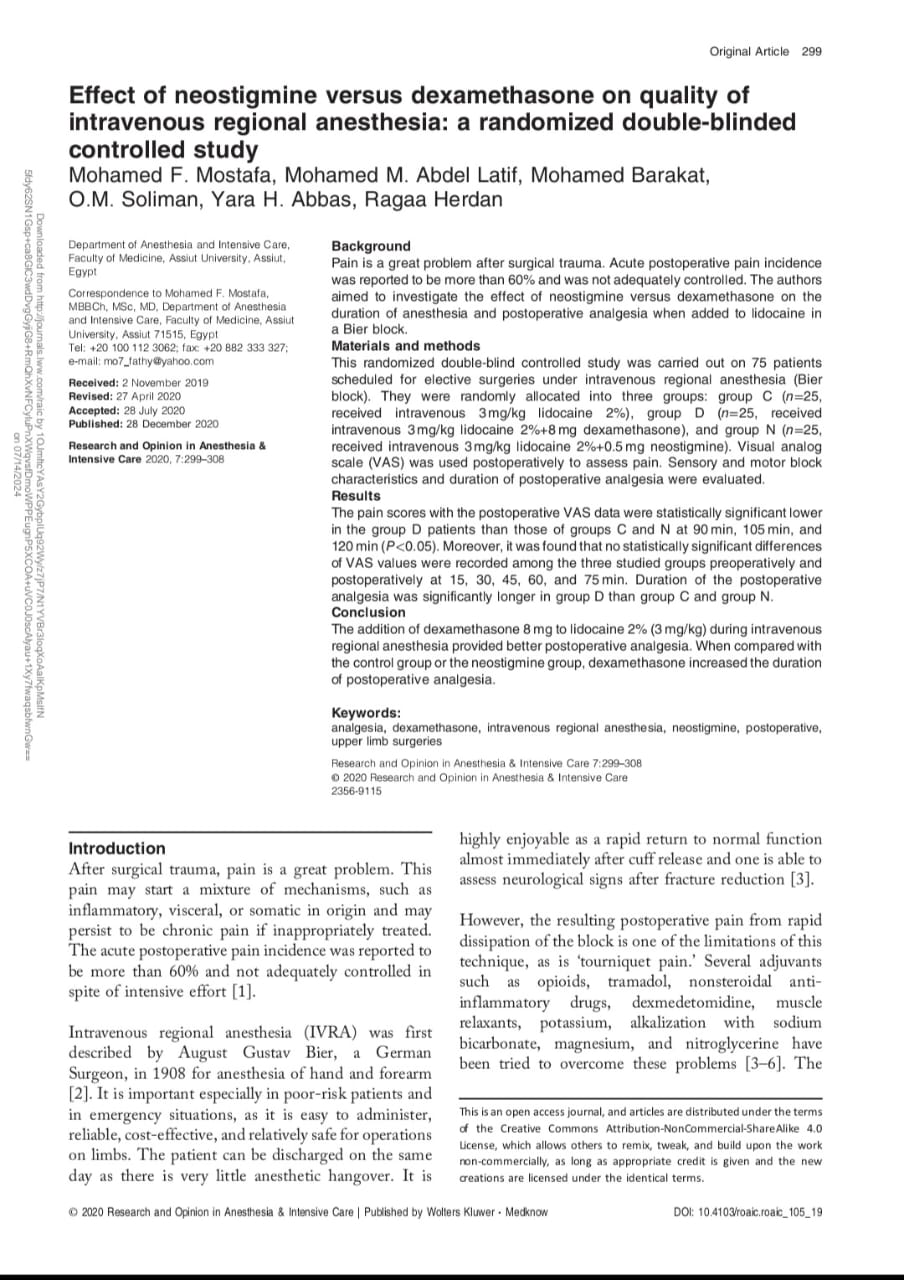
Effect of neostigmine versus dexamethasone on quality of intravenous regional anesthesia: a randomized double-blinded controlled study

Research Abstract

Background
Pain is a great problem after surgical trauma. Acute postoperative pain incidence
was reported to be more than 60% and was not adequately controlled. The authors
aimed to investigate the effect of neostigmine versus dexamethasone on the
duration of anesthesia and postoperative analgesia when added to lidocaine in
a Bier block.
Materials and methods
This randomized double-blind controlled study was carried out on 75 patients
scheduled for elective surgeries under intravenous regional anesthesia (Bier
block). They were randomly allocated into three groups: group C (n=25,
received intravenous 3 mg/kg lidocaine 2%), group D (n=25, received
intravenous 3 mg/kg lidocaine 2%+8 mg dexamethasone), and group N (n=25,
received intravenous 3 mg/kg lidocaine 2%+0.5 mg neostigmine). Visual analog
scale (VAS) was used postoperatively to assess pain. Sensory and motor block
characteristics and duration of postoperative analgesia were evaluated.
Results
The pain scores with the postoperative VAS data were statistically significant lower
in the group D patients than those of groups C and N at 90 min, 105 min, and
120 min (P<0.05). Moreover, it was found that no statistically significant differences
of VAS values were recorded among the three studied groups preoperatively and
postoperatively at 15, 30, 45, 60, and 75 min. Duration of the postoperative
analgesia was significantly longer in group D than group C and group N.
Conclusion
The addition of dexamethasone 8 mg to lidocaine 2% (3 mg/kg) during intravenous
regional anesthesia provided better postoperative analgesia. When compared with
the control group or the neostigmine group, dexamethasone increased the duration
of postoperative analgesia.

Research Authors
Mohamed F. Mostafa, Mohamed M. Abdel Latif, Mohamed Barakat, O.M. Soliman, Yara H. Abbas, Ragaa Herdan
Research Date
Research Image
Effect of neostigmine versus dexamethasone on quality of intravenous regional anesthesia: a randomized double-blinded controlled study
Research Journal
Research and Opinion in Anesthesia & Intensive Care
Research Member
Research Pages
299-308
Research Publisher
Wolters Kluwer - Medknow
Research Rank
Indexed Journal
Research Vol
7
Research Website
DOI: 10.4103/roaic.roaic_105_19
Research Year
2020
Subscribe to