

16.3.1 - The University's expert guidance offered to the government
16.2.7 -The University's financial data
16.2.6 - The University's supporting academic freedom policy
16.2.5 -The University's publication of its legal principles and commitments
SDG16
Details:
16.2.3 -The University's policies to engage with local stakeholders
16.2.2 - The University's Students' Union recognition
SDG16
Details:
- Name_student.
- Faculty of Education Students’ Union.
- Student Union News.
- The Financial and Administrative Regulations of Student Unions.
- Student Union Activities.
- Formation of the Students’ Unions Council.
- Formation of the University Students’ Union Council.
- Student Unions Youth Welfare.
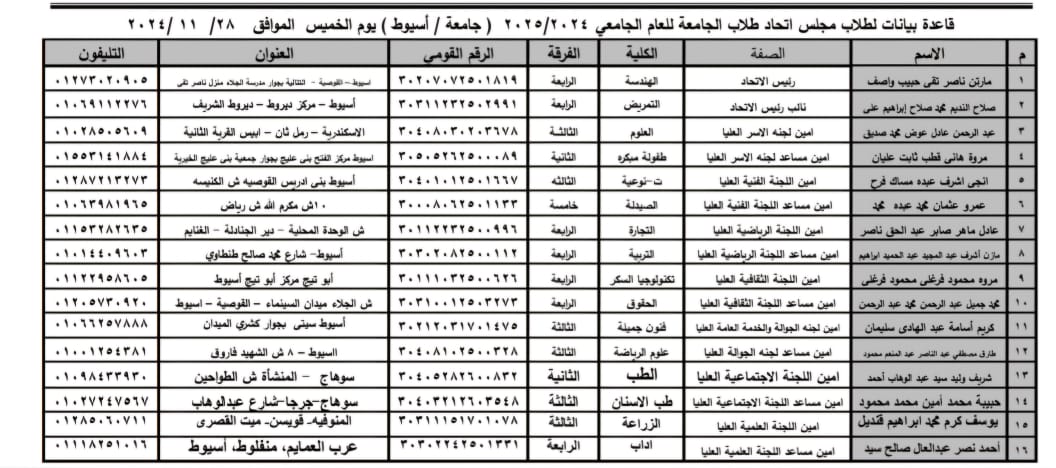
Assiut University announces the initial lists of the candidacy of 1113 students in the elections
15.4.3 - The University's practices regarding waste disposal /covering hazardous materials
SDG15
Details:
Assiut University has a formal waste disposal policy that includes the management of hazardous materials and hazardous waste. The university's waste management framework distinguishes between ordinary and hazardous waste and provides procedures for the safe handling, collection, treatment, and disposal of hazardous materials.
The university implements specific measures for hazardous waste disposal. Hazardous waste is collected in designated red bags, handled by trained personnel using appropriate personal protective equipment (PPE), and transferred to the incinerator complex at Assiut University Hospitals for safe disposal. The university also operates under a cooperation protocol with the Ministry of Health for hazardous waste incineration and utilizes sterilization and treatment equipment for medical and infectious waste.
Furthermore, the university's waste management policy covers various categories of hazardous waste, including medical waste, infectious materials, pathological waste, sharp materials, radioactive materials, and electronic waste, ensuring proper environmental and health protection.
https://www.aun.edu.eg/AUIRO/index.php/en/node/27776
3-11 medical waste
15.4.2 - The University's policy on reducing plastic waste on campus
SDG15
Details:
Assiut University has adopted a Policy for Reducing Paper and Plastic Usage on Campus aimed at minimizing the environmental impacts of plastic consumption and promoting sustainable alternatives. The policy specifically seeks to reduce plastic waste by encouraging the use of eco-friendly alternatives, reusable and refillable containers, and awareness programs for students and staff. It also promotes replacing bottled water with water dispensers, using paper cups instead of plastic cups, and adopting biodegradable or non-plastic cleaning materials.
The policy further supports digital transformation measures that reduce resource consumption and increase environmental sustainability across campus operations. Environmental awareness campaigns are conducted to encourage the university community to reduce plastic use and adopt sustainable practices.
In addition, Assiut University's policy on preventing and reducing pollution includes provisions to ban single-use plastics on campus and promote environmentally friendly alternatives, alongside educational initiatives that encourage the use of reusable materials.
Evidence
- Assiut University Policy for Reducing Paper and Plastic Usage on Campus:
- Assiut University Policy on Preventing and Reducing Marine Pollution from Land-Based Activities (includes measures on single-use plastics):
https://www.aun.edu.eg/AUIRO/sites/default/files/plastic%20policy.pdf
https://www.aun.edu.eg/AUIRO/sites/default/files/11%20policy%20marine%20pollution.pdf
The University's water quality standards
SDG15
Details:
Yes. Assiut University has formal policies and guidelines to uphold water quality and manage water discharges in order to protect ecosystems, wildlife, and human health.
Modern irrigation technologies to minimize water loss and promote sustainability.
Water Quality Monitoring: The university monitors water quality in local water bodies and campus facilities, comparing results with Egyptian Law No. 458/2007 and WHO guidelines for drinking and discharge standards.
Environmental Stewardship Program: Assiut University runs programs to protect and restore aquatic ecosystems, which include monitoring water quality and biodiversity, and offering grants for research on improving water quality.
Environmental Stewardship Program – Assiut UniversityCommunity Service and Environmental Development Sector: Oversees compliance with environmental regulations, including water discharge standards, and implements training programs for sustainable water management.
Environmental Affairs Sector – Assiut University
https://www.aun.edu.eg/AUIRO/sites/default/files/program%20for%20stewardship.pdf
https://www.aun.edu.eg/main/sector/environmental/affairs
Wastewater Treatment and Reuse: The university operates wastewater treatment facilities to ensure that discharged water meets safety standards before entering local water systems. This prevents pollution and protects aquatic ecosystems. In details, the University applies a comprehensive water management policy that includes the treatment and reuse of wastewater and greywater in accordance with the Egyptian Code for Wastewater Reuse (2015). Treated water is used only for approved purposes, particularly the irrigation of green areas, ensuring that water discharge and reuse activities comply with national environmental and public health requirements.
To maintain water quality, Assiut University employs digital monitoring systems and Geographic Information Systems (GIS) to continuously monitor water quality, distribution networks, and consumption patterns across its campuses. Regular inspections are conducted to detect leaks and prevent contamination or unnecessary water losses.
The University also minimizes the discharge of potable water by:
Reusing treated wastewater and greywater for landscape irrigation.
Collecting and reusing condensate water from air-conditioning systems.
Utilizing modern irrigation systems, including drip, sprinkler, and mist irrigation technologies, to ensure efficient water application and reduce runoff.
Conducting scientific assessments of crop water requirements through lysimeter-based studies to optimize irrigation practices and prevent overwatering.
These measures help safeguard local ecosystems, reduce pressure on freshwater resources, improve water-use efficiency, and ensure that water management practices support environmental sustainability and human well-being.
Through these integrated policies and monitoring mechanisms, Assiut University demonstrates a strong commitment to maintaining water quality standards and responsible water discharge management across its campuses and agricultural facilities.
 |
https://aun.edu.eg/AUIRO/sites/default/files/waterWastAll.pdf