

5.6.4 childcare facilities for students which allow recent mothers to attend university courses
2.5.4 Prioritise purchase of products from local, sustainable sources
SDG2
Details:

Assiut University
Purchasing Policy
Egypt launched in 2016 its first version of the National Strategy for Sustainable Development
commonly known as the “Egypt Vision 2030”. This vision was made as a cornerstone for broad
developmental processes to tackle the Egyptian’s grand challenges to secure a dignified and decent
life for the Egyptian people. The vision identified several strategic goals, among which were the
diversified and knowledge-based economy, and the governance and cooperation, which encompass
several main goals, such as administration sector reform, transparency, ant-corruption strategy, and
inclusive monetary system. In this context, Assiut University followed the “Egypt Vision 2030” and the
National Anti-corruption Legislation, and designed its Purchasing Policy as follows:
1- Purchasing national instruments instead of foreign imported instruments for sustainable
development and support to the national industry and economy.
2- Purchasing foreign imported instruments in case of having no national alternatives, but those
foreign instruments must incorporate high percentages of national added value to support
transferring high technologies to Egypt.
3- Purchasing national instruments and chemicals must abide to the Egyptian Environmental
Protection Law, where the use of the instruments and chemicals must help protect the
environment from air, land, and/or water pollutions.
4- Purchasing of national/international imported instruments must be energy-saving and
preferably those depend on electricity and/or renewable energy instead fossil fuel.
5- Purchasing of national/international imported instruments that depend on fossil fuel must follow
the Egyptian legislations of environmental protection, and most importantly produce low
carbon emission to help minimize the total amount of greenhouse gases, and thus reduce the
carbon footprint.
6- Purchasing of foods and/or domestic goods for practical teaching, student events, workshops,
conferences, etc.. is preferred to be directed to the Assiut University Food Production
Facilitates (Faculty of Agriculture and Faculty of Veterinary) and to local merchants as
alternatives to reduce energy consumption needed for goods/food transportation and thus
minimizes the carbon footprint.
7- Purchasing of goods and material for practical teaching, student events, workshops,
conferences, etc.. is preferred to be hand-made to reduce energy consumption and minimize
the carbon footprint.
8- Purchasing of foods for any university events is preferred to focus on vegetarian diets and to
minimize purchasing of meat and other dairy products to minimize emission of the greenhouse
gases (methane and carbon dioxides).
9- Purchasing of goods and office materials for administration work, teaching, and any university
event is preferred to be recyclable.
10- The university develop and maintain e-payment services, where all purchasing and payment
processes must be run via the university e-payment system.
11- Payment in cash is limited up to 500 Egyptian Pounds (LE) and any higher amount must be
paid via the e-payment services to minimize the use of cotton/linen and plastic-made bank
notes to help protect the environment.
12- Purchasing of biological and/or botanical materials for university teaching and/or research
purposes must follow the ethical rules and guides provided by the Assiut University
Research Ethics Central Committee (AUREC).
13- Payment of goods and instruments for university teaching and/or research purposes must be
checked by the General Administration for Internal Review and Governance to assure that
university specifications and purchasing rules are met.
14- Purchasing of similar goods and instruments for university teaching and/or research purposes
must be made via the bulk purchasing system of the university.
15- Purchasing of instruments for university teaching and/or research purposes must be
accompanied with a valid maintenance contract for sustainable use of these instruments on
the long run.
16- Person/Faculty staff/Student who is in charge of purchasing of any materials for the
university/faculty must adhere to Anticorruption-Rules, Code of Ethics for University
Staff, Code of Ethics for Public Sector Employee, and Code of Ethics for University Students.
17.2.5 collaborate with NGOs to tackle the SDGs
13.3.5 - The University's collaboration with NGOs regarding climate adaptation
SDG13
Details:
Cooperative Climate Action and Planning
NGO Partnerships on Climate Adaptation: Collaborating with NGOs, Assiut University supports initiatives focused on climate
adaptation. These partnerships strengthen local resilience efforts, addressing both immediate and long-term climate challenges.
Tree Planting Initiatives at Assiut University under the "Go Green" Initiative
• 4,000 Jojoba trees were planted at the Faculty of Agriculture's demonstration farm, in collaboration with the Egyptian-Gulf
Agricultural Land Company .
• Recently, a nursery for mahogany trees—high-quality wood for furniture making—was established, utilizing
wastewater/industrial drainage/well water.
• 655 fruit trees and 612 non-fruit trees were planted across the Assiut University campus.
• Under the presidential "100 million Trees" initiative, 1,000 fruit trees were planted at Assiut University during the International
Conference on Development and the Environment in the Arab World.
Stemming from the university's environmental commitment, despite the lack of hydropower plants, solar panels, or wind turbines for generating renewable energy, the university has a significant percentage of renewable energy production projects carried out by STEM students (approximately 80% of their projects), under the supervision of professors from the Faculties of Science, Engineering, and Education."
TerraNova Tech Project
In Egypt, rapid population growth and climate change pose significant challenges to natural resources and agricultural production. The increasing population leads to greater consumption of water and soil, while climate change exacerbates issues such as drought and soil degradation. To address these challenges, we have designed a system that combines bio-fertilization using Red Wigglers to produce vermicompost with a smart irrigation system powered by an electric adaptor. This system helps enhance soil fertility naturally and reduce water consumption through precise irrigation control, making it a practical and cost-effective solution to support sustainable agriculture in the face of climate change and growing population pressure.


M.O.R.G bridge Project
In Egypt, urban congestion is a major challenge caused by rapid population growth and limited infrastructure, leading to traffic delays, pollution, and economic losses. To address this issue, stem students designed a hydraulic bridge based on Pascal’s Law, which uses a simple syringepowered hydraulic system to lift and move the bridge efficiently. This solution provides a cost-effective and energy-saving method to reduce congestion and improve traffic flow.

Generating energy using foot step Project
The project is a bold step towards redefining the relationship between human activity and energy sources. The project aims to harness the kinetic energy generated by footsteps and convert it into usable electrical energy, providing an innovative and sustainable solution to the growing energy challenges. The system was designed using pressure sensors capable of capturing the force generated by footsteps and converting it into electrical energy via an integrated electronic system. The study focused on testing the prototype in different environments to determine its efficiency in generating energy. The results showed that the system was able to produce limited amounts of energy, but it was not enough to operate electricaldevices such as lamps continuously. It was determined that increasing the number of pressure sensors and improving the system design could significantly increase its efficiency.

Corn cobs for Eco-friendly life Project
Egypt faces many challenges that affect environmental sustainability and sustainable development, and from here the idea of the smart home emerged to achieve environmental sustainability with the introduction and use of technology to improve the efficiency of energy and resource consumption and reduce the environmental impact resulting from home use. Therefore, Stem Students built a smart, sustainable home from environmentally friendly materials. After researching, we found many ideas and chose corncob as a basic material for construction because it is a strong material and has many characteristics, including its ability to withstand high temperatures, resistance to corrosion, and many other characteristics and features. Painting it from the inside with a mixture of clay and wheat straw as an agent that helps and increases the regulation of humidity and lowers the temperature. Students made supports for the house from palm stems, as they are natural and inexpensive wood. Since it is a smart home, we decided on the idea of a sensor that runs on electricity and saves energy After searching for a sensor to place in the home, it is found many types of sensors, but we chose the HC-SR501 IR thermal motion sensor to turn off the electricity when the person is not in the place and turn it on when he is present.


Generating Electricity from wind Energy Project

Generating electricity By Road Hump Project
Stem Students proposed a model for generating electricity from road humps. This innovative approach involves converting the vibrations caused by vehicles passing over the hump into electrical energy. This is achieved by incorporating piezoelectric sensors into the road hump's spring system. These sensors harness the pressure exerted by the vehicle's weight, transforming the resulting vibrations into a usable electrical current.


Smart Home Project
Our innovative idea focuses on constructing houses using natural materials such as clay, hay, and fronds, known for their insulating properties and environmental sustainability. These materials help regulate indoor temperatures, keeping the interior cool in hot climates.

CASR Eco Brick Project
The main idea is to produce bricks using environmentally friendly materials in order to reduce pollution. As the population continues to grow, the demand for construction increases. However, we want to avoid using materials that harm the environment. That's why we chose to create our bricks from sugarcane waste, which is a sustainable and eco – friendly alternative.

Energy for life Project
The main idea Is how to generate volts of energy with environmental resources and chlorine as an essential element in the project [Galvanic cell].

PV Stand Alone System for Green Hydrogen Generation and Storage for a House Hybrid Loads Project
At the Faculty of Engineering, Assiut University, Project No. 46069, “PV Stand Alone System for Green Hydrogen Generation and Storage for a House Hybrid Loads,” is a 24-month STDF-funded project led by Prof. Dr. Mohamed Abdel Azim Ibrahim Nayel at the Faculty of Engineering, Assiut University. The project develops an off-grid photovoltaic system integrated with batteries, a fuel cell, a hydrogen tank, an electrolyzer, and advanced control strategies to supply hybrid household loads efficiently. It supports renewable energy use, green hydrogen generation, clean cooking through HHO electrolyzer design, and demand-side management. The work includes system modeling, MPPT improvement using PSO-MPC, laboratory setup, prototype testing, student training, and international scientific publications.
https://www.mdpi.com/1996-1073/19/2/452
https://ieeexplore.ieee.org/abstract/document/10701066
https://www.mdpi.com/1996-1073/18/13/3395
https://ieeexplore.ieee.org/abstract/document/10119610
Cell Temperature and Electrical Efficiency of Dusty Photovoltaic Modules as an Alert for Module Cleaning in Benban Solar Farm in
Aswan: Calculation and Experimental Validation Project This project aims to investigate the impact of environmental factors on the performance of photovoltaic (PV) modules, particularly dust accumulation and cell temperature. These factors significantly affect the efficiency of solar power systems, especially in desert regions such as Benban Solar Park in Aswan, Egypt. Dust deposition on the surface of PV modules reduces the amount of solar irradiance reaching the solar cells, which leads to a decrease in the generated electrical power. In addition, the increase in cell temperature during operation negatively affects the electrical characteristics of the modules, causing a reduction in output voltage and overall efficiency. The project focuses on analyzing the electrical behavior of photovoltaic modules through current–voltage (I–V) and power–voltage (P–V) characteristics. Mathematical modeling is used to evaluate the influence of temperature and dust accumulation on PV system performance. Furthermore, experimental measurements are conducted to validate the theoretical analysis and compare the performance of clean and dusty modules. The ultimate objective of this project is to develop a practical indicator that utilizes the variation in cell temperature and electrical efficiency as an early alert for determining the optimal cleaning time of photovoltaic modules. This approach can help improve energy production and reduce efficiency losses in large-scale solar power plants such as the Benban Solar Farm. This calls for purchasing an instrument to measure directly the power loss due to dust accumulation on the module surface.
Techno-Economic Study of Utilizing Wind Energy Resulting From Moving Vehicles For A Highway Illumination Project
At the Faculty of Engineering, Assiut University, the students introduce a Project with the objective of Harvesting Highway Wind. This project selects an innovative deployment of vertical-axis wind turbines (VAWTs) along highway vehicles to harness the aerodynamic turbulence generated by high-speed traffic. This project aims to explore the feasibility of generating electrical energy from the wind produced by moving vehicles on highways using Vertical Axis Wind Turbines (VAWT), which are considered promising systems for extracting wind energy in urban and high-traffic environments. Field measurements were conducted to record the wind velocity generated by passing vehicles at a distance of one meter from the turbine’s proposed location, alongside recording the actual speed and type of each vehicle. The analyzed vehicle types included private cars (Sedan), minibuses, and minitrucks. With the determination of the wind velocity in the vehicle wake, one can calculate the power in the wing. With the use of a given wind turbine, the amount of energy generated by each vehicle type is calculated. To assess the practical viability of this concept, the results are applied to a real highway as a case study. The Cairo–Alexandria Agricultural Road is selected due to its importance as one of Egypt’s major transportation corridors, extending approximately 220 kilometers with 8 lanes (4 in each direction), and characterized by heavy and dense daily traffic. The average daily traffic volume on this road is approximately 110,554 vehicles. There is an approximate percentage of about 30% of these vehicles that usually use the left (fast) lane closest to the roadside, which is close to where the proposed turbine is installed. The findings estimate that the total daily energy produced by vehicles using the roadside lane is around 187,601 joules, equivalent to 52.11 watt-hours per day per turbine, i.e., around 19 kilowatt-hours per year. Although this amount of energy appears modest and currently insufficient for powering large lighting systems or integrated infrastructure, it opens the door for potential use in low-consumption applications, such as traffic signal lighting or powering roadside smart sensors and lamps.


Optimal Sizing of PV System to Meet the Electrical and Water Demands of a Multipurpose Agricultural Farm Project
The study presents the design and optimization of a Photovoltaic Water Pumping System (PVWPS) for a 50-acre farm in New Assiut City to replace a grid-powered pumping system. Four system configurations and two load scenarios were analyzed using a Multi-Objective Genetic Algorithm (MOGA) to minimize energy cost and greenhouse gas emissions while ensuring reliable operation. Results show that water storage is the best standalone solution for irrigation loads, while hybrid storage is optimal for combined irrigation and building loads. The study highlights the potential of PVWPSs to improve agricultural sustainability and support Egypt’s renewable energy and environmental objectives.

Project Overview: The 3D-Printed Scout
The 3D-Printed Scout is an innovative, cost-effective scientific project. It was developed entirely within the labs of the Physics Department at Assiut University. It was developed as part of the university's initiative to combat environmental and climate challenges, supporting eco-friendly and resources was optimized academic research.
1. Eco-Friendly & Egyptian-Made: Locally fabricated in Egypt using sustainable, environmentally friendly materials.
2. Wind Energy Generation: Generates clean electrical power utilizing an integrated vertical-axis wind turbine (VAWT).
3. Solar-Powered Integration: Operates with solar energy as an additional, reliable auxiliary power source.
4. Automated Smart Lighting: Illuminates automatically when pedestrians pass underneath, managed by responsive infrared (PIR) motion sensors.
5. Integrated Wi-Fi Extender: Functions as a network signal amplifier to expand local Wi-Fi coverage area.

- Stemming from the university's environmental commitment, despite the lack of hydropower plants, solar panels, or wind turbines for generating renewable energy, the university has a significant percentage of renewable energy production projects carried out by STEM students (approximately 80% of their projects), under the supervision of professors from the Faculties of Science, Engineering, and Education."


Generating Electricity using the Project:

"On Monday, November 11, [2024], Dr. Ahmed El-Menshawy, President of Assiut University, inaugurated the environmental projects exhibition for fourth-year students of the STEM Bachelor's program at the Faculty of Education. This took place in the presence of Dr. Ahmed Abdel-Mawla, Vice President of the University for Education and Student Affairs, Dr. Mahmoud Abdel-Aleem, Vice President of the University for Community Service and Environmental Development, and Dr. Gamal Bader, Vice President of the University for Postgraduate Studies and Research, and under the supervision of Dr. Hassan Heweil, Dean of the Faculty of Education, Dr. Mohamed Gaber Kassem, Vice Dean of the Faculty for Education and Student Affairs, and Dr. Marian Milad, Professor in the Department of Curricula and Teaching Methods at the Faculty of Education and STEM Program Coordinator. The exhibition is part of the 9th International Conference of the Faculty of Education, held over two days, November 11 and 12, under the title 'The Role of Arab Education in Achieving Sustainable Development Goals.' Dr. Ahmed El-Menshawy inspected the student products included in the exhibition, which consisted of applied products based on the academic and theoretical studies conducted by the students throughout their years in the STEM program. These products offered innovative solutions to contemporary societal challenges and problems, using modern technologies, in line with Egypt's Vision 2030. Examples included: a staircase project for generating electricity, an electronic application project for kidney dialysis patients, a plastic tile project resulting from the recycling of plastic waste, a device project for re-purifying electricity, a furnace project for burning waste and generating electricity, and a solar-powered farm project (STEM students' projects.pdf). Dr. Ahmed El-Menshawy praised the student projects featured in the exhibition, which highlighted the students' creative and scientific skills and their ability to apply their theoretical studies in the form of practical projects that contribute to solving contemporary societal and environmental problems. He affirmed that the exhibition is an opportunity to qualify student cadres for the labor market and to refine their talents and skills in implementing projects, thus benefiting society and promoting sustainable development. These projects were inaugurated in the exhibition opened by Professor Dr. El-Menshawy, the University President."

"Students of the STEM Teacher Preparation Program, from the first to the fourth year, present their Capstone course projects (this course is taught over four years = 8 academic semesters) focusing on rationalizing energy consumption and generating it in an innovative way. Among the innovative energy conservation projects by STEM students is: a speed bump that converts kinetic energy into electrical energy through a sensor. The generated energy is then stored in batteries to be used for lighting streetlamps and traffic signals."


"STEM students also presented an innovative idea for extracting groundwater by generating electricity from sunlight using an LED."


The projects implemented at the university to address climate change: A total of 7 projects will be executed at a total cost of 1.5 million euros as part of the "Improving Energy Efficiency in University Buildings" project, which involves 18 Egyptian public universities under the supervision of the Supreme Council of Universities and funded by the German Reconstruction Bank (KFW). These projects are considered models that can be expanded in the future at the level of Assiut University and will lead to a reduction in consumption by approximately 3.2 gigawatt-hours. The green projects, which emerged from the initiative of Assiut University, were adopted, where two teams of students from the Assiut University Green Initiative won second and fourth places during their participation in the global "Climathon" conference, organized by the Ministry of Environment in collaboration with the European Union and the German International Cooperation Agency in Egypt on October 30 and 31, 2023, under the title "Climathon Upper Egypt - Towards Localizing the National Climate Change Strategy Egypt 2050." This was under the supervision of Professor Dr. Ahmed El-Manshawi, President of the University, and Professor Dr. Mahmoud Abdel-Aleem, Vice President of the University for Community Service and Environmental Development. The participation of Assiut University in the activities of the Climate Summit of Upper Egypt came within the framework of efforts aimed at achieving sustainable development in the context of implementing Egypt Vision 2030, through environmental preservation to improve the quality of life, considering the rights of future generations, and implementing the National Climate Change Strategy 2050.
The team (Eco-Fuel Innovators) won second place for their project on recycling solid agricultural waste, especially rice straw, sorghum husks, and other agricultural residues that farmers burn, leading to the emission of harmful greenhouse gases and resulting in environmental pollution. The student team includes:
Shamous Abdel-Sami (Faculty of Science), Dina Gamal Abdel-Nasser (Faculty of Engineering), and Bula Francis Habib (Faculty of Engineering).
The concept of Eco-Fuel is based on recycling solid agricultural waste, especially rice straw, fine corn husks, and other agricultural residues that farmers burn, leading to the emission of harmful greenhouse gases and resulting in environmental pollution. By using anaerobic bacteria and the fermentation process, these residues are converted into biogas as a primary product and other secondary products such as animal feed. • The team (Blast-tech) also won fourth place for their project on extracting diesel fuel from plastic through pyrolysis and processing to produce environmentally safe fuel, reduce carbon emissions resulting from plastic waste accumulation, and mitigate climate change. The student team includes: Yusuf Mohamed (Faculty of Engineering), Nuran Alaa El-Din (Faculty of Agriculture), and Zainab Abdel-Mawla (Faculty of Medicine). • The University of Assiut also encouraged one of the green project teams to implement the "Liquid Tree" project, which revolves around creating a container that holds 600 liters of water. Microalgae use carbon dioxide and produce pure oxygen through photosynthesis. In this way, the Liquid Tree is considered a tangible and effective solution to reduce emissions and improve air quality in densely populated cities where green spaces may be limited. The initiative of Assiut University Green aims to raise environmental awareness among students and university staff regarding sustainability, in addition to implementing work strategies to mitigate the impact of climate change for the benefit of our community.
13.3.3 -The University-government partnerships to face climate change issues
Details:
Assiut University actively uses Information and Communication Technology (ICT) in the planning, implementation, monitoring, and evaluation of its Energy and Climate Change strategies in alignment with SDG13.
• Planning:
• GIS mapping and renewable energy simulation software are used to identify suitable locations for
solar and wind energy installations.
• The university promotes climate awareness via digital platforms across 312 undergraduate and 134
postgraduate courses related to climate action and sustainability.
• Implementation:
• ICT-based project management tools are used during the installation of solar panels and energyefficient
systems.
• In 2023, 18% of total university energy consumption (112,508 GJ out of 182,124 GJ) came from lowcarbon
sources.
• Clean energy agriculture projects, such as Jojoba cultivation, are monitored using digital tools.
• Monitoring:
• Renewable energy output, electricity consumption, and CO₂ emissions are continuously tracked
through digital dashboards and smart metering systems.
• Data is recorded and analyzed to ensure progress toward emissions reduction.
• Evaluation:
• The university follows the Greenhouse Gas (GHG) Protocol framework for evaluating its carbon
footprint and planning for carbon neutrality.
• ICT supports documentation and reporting of climate mitigation activities, including:
o 4,000 Jojoba trees planted,
o 1,000 fruit trees planted in 2024 under the “100 Million Trees” initiative,
o Digital monitoring of waste reduction and eco-friendly transportation initiatives.

13.3.2 - Climate Action plan
SDG13
Details:
Assiut University is actively contributing to the international efforts in protecting our climate. Including carbon reduction,and environmental education. Through energy efficiency measures, educational programs, partnerships, and a commitment to carbon
neutrality.
1. Measuring and Reducing Carbon Emissions
Low-Carbon Energy Use: Assiut University has made important improvement in low-carbon energy consumption.
Carbon Footprint Education: As part of the First Student Green Dream Conference, Assiut University hosted a seminar on the "Carbon Footprint," emphasizing the importance of carbon reduction strategies to students and the broader campus community.
Clean Energy in Agriculture: The university’s Faculty of Agriculture is cultivating Jojoba, an eco-friendly plant, as a clean energy source. Jojoba is an industrial crop resilient to desertification and climate change, illustrating Assiut University’s commitment to sustainable agricultural practices.
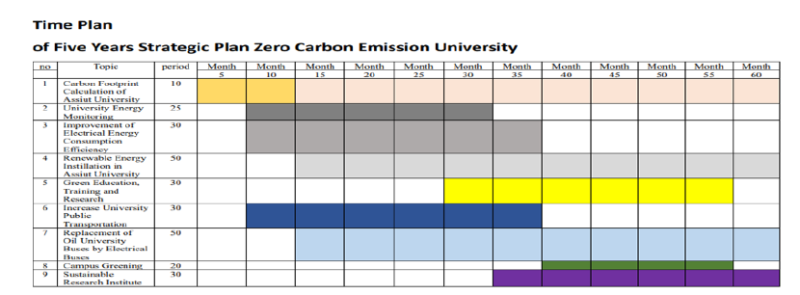
Commitment to Carbon Neutrality
• Carbon Neutrality Strategy: Assiut University aims to become a carbon-neutral campus by following the Greenhouse Gas Protocols. Key strategies include.
Building Efficiency: Advancing in energy-efficient buildings and green construction practices.
• Transportation Initiatives: Promoting eco-friendly transportation options to minimize emissions.
• Waste Management: Introducing efficient waste management practices, including recycling and composting, to reduce campus waste.
• Tree Planting for Carbon reduction: As part of the "Go Green" Initiative, Assiut University planted 4,000 Jojoba trees and expanded to other tree species, such as mahogany and eucalyptus, in the following years. These trees sequester CO₂, contributing to the university’s climate adaptation and emission reduction goals. Recently, under Egypt’s "100 million Trees"
initiative, the university planted 1,000 additional fruit trees to support carbon absorption and enhance green spaces.
Local Ecosystem Maintenance and Pollution Prevention
Plastic and Paper Waste Reduction: The university has a dedicated policy to reduce paper and plastic waste on campus by promoting electronic exams and communication, reusable containers, and recyclable materials. These measures aim to decrease waste generation and promote sustainable resource use.
13.3.1 -Local education programs/campaigns on climate change consequences.
SDG13
Details:
Educational Programs on Climate Change: Assiut University has undergraduate courses and postgraduate courses that address climate and environmental sustainability. Additionally, specialized programs and new courses have been introduced to enhance climate sustainability awareness among students.
• Climate Research: The University endorses climate-related research by offering studies, joint supervisions, scientific missions, and international scholarships. This led to published articles and books and book chapters on climate and environmental sustainability.
• Environmental Conferences and Seminars: Assiut University organized the international conferences to provide a platform for experts to discuss sustainability and environmental challenges.
Stemming from the university's environmental commitment, despite the lack of hydropower plants, solar panels, or wind turbines for generating renewable energy, the university has a significant percentage of renewable energy production projects carried out by STEM students (approximately 80% of their projects), under the supervision of professors from the Faculties of Science, Engineering, and Education."
TerraNova Tech Project
In Egypt, rapid population growth and climate change pose significant challenges to natural resources and agricultural production. The increasing population leads to greater consumption of water and soil, while climate change exacerbates issues such as drought and soil degradation. To address these challenges, we have designed a system that combines bio-fertilization using Red Wigglers to produce vermicompost with a smart irrigation system powered by an electric adaptor. This system helps enhance soil fertility naturally and reduce water consumption through precise irrigation control, making it a practical and cost-effective solution to support sustainable agriculture in the face of climate change and growing population pressure.
M.O.R.G bridge Project
In Egypt, urban congestion is a major challenge caused by rapid population growth and limited infrastructure, leading to traffic delays, pollution, and economic losses. To address this issue, stem students designed a hydraulic bridge based on Pascal’s Law, which uses a simple syringepowered hydraulic system to lift and move the bridge efficiently. This solution provides a cost-effective and energy-saving method to reduce congestion and improve traffic flow.
Generating energy using foot step Project
The project is a bold step towards redefining the relationship between human activity and energy sources. The project aims to harness the kinetic energy generated by footsteps and convert it into usable electrical energy, providing an innovative and sustainable solution to the growing energy challenges. The system was designed using pressure sensors capable of capturing the force generated by footsteps and converting it into electrical energy via an integrated electronic system. The study focused on testing the prototype in different environments to determine its efficiency in generating energy. The results showed that the system was able to produce limited amounts of energy, but it was not enough to operate electricaldevices such as lamps continuously. It was determined that increasing the number of pressure sensors and improving the system design could significantly increase its efficiency.
Corn cobs for Eco-friendly life Project
Egypt faces many challenges that affect environmental sustainability and sustainable development, and from here the idea of the smart home emerged to achieve environmental sustainability with the introduction and use of technology to improve the efficiency of energy and resource consumption and reduce the environmental impact resulting from home use. Therefore, Stem Students built a smart, sustainable home from environmentally friendly materials. After researching, we found many ideas and chose corncob as a basic material for construction because it is a strong material and has many characteristics, including its ability to withstand high temperatures, resistance to corrosion, and many other characteristics and features. Painting it from the inside with a mixture of clay and wheat straw as an agent that helps and increases the regulation of humidity and lowers the temperature. Students made supports for the house from palm stems, as they are natural and inexpensive wood. Since it is a smart home, we decided on the idea of a sensor that runs on electricity and saves energy After searching for a sensor to place in the home, it is found many types of sensors, but we chose the HC-SR501 IR thermal motion sensor to turn off the electricity when the person is not in the place and turn it on when he is present.
Generating Electricity from wind Energy Project
Generating electricity By Road Hump Project
Stem Students proposed a model for generating electricity from road humps. This innovative approach involves converting the vibrations caused by vehicles passing over the hump into electrical energy. This is achieved by incorporating piezoelectric sensors into the road hump's spring system. These sensors harness the pressure exerted by the vehicle's weight, transforming the resulting vibrations into a usable electrical current.
Smart Home Project
Our innovative idea focuses on constructing houses using natural materials such as clay, hay, and fronds, known for their insulating properties and environmental sustainability. These materials help regulate indoor temperatures, keeping the interior cool in hot climates.
CASR Eco Brick Project
The main idea is to produce bricks using environmentally friendly materials in order to reduce pollution. As the population continues to grow, the demand for construction increases. However, we want to avoid using materials that harm the environment. That's why we chose to create our bricks from sugarcane waste, which is a sustainable and eco – friendly alternative.
Energy for life Project
The main idea Is how to generate volts of energy with environmental resources and chlorine as an essential element in the project [Galvanic cell].
PV Stand Alone System for Green Hydrogen Generation and Storage for a House Hybrid Loads Project
At the Faculty of Engineering, Assiut University, Project No. 46069, “PV Stand Alone System for Green Hydrogen Generation and Storage for a House Hybrid Loads,” is a 24-month STDF-funded project led by Prof. Dr. Mohamed Abdel Azim Ibrahim Nayel at the Faculty of Engineering, Assiut University. The project develops an off-grid photovoltaic system integrated with batteries, a fuel cell, a hydrogen tank, an electrolyzer, and advanced control strategies to supply hybrid household loads efficiently. It supports renewable energy use, green hydrogen generation, clean cooking through HHO electrolyzer design, and demand-side management. The work includes system modeling, MPPT improvement using PSO-MPC,laboratory setup, prototype testing, student training, and international scientific publications.
https://www.mdpi.com/1996-1073/19/2/452
https://ieeexplore.ieee.org/abstract/document/10701066
https://www.mdpi.com/1996-1073/18/13/3395
https://ieeexplore.ieee.org/abstract/document/10119610
Cell Temperature and Electrical Efficiency of Dusty Photovoltaic Modules as an Alert for Module Cleaning in Benban Solar Farm in
Aswan: Calculation and Experimental Validation Project This project aims to investigate the impact of environmental factors on the performance of photovoltaic (PV) modules, particularly dust accumulation and cell temperature. These factors significantly affect the efficiency of solar power systems, especially in desert regions such as Benban Solar Park in Aswan, Egypt. Dust deposition on the surface of PV modules reduces the amount of solar irradiance reaching the solar cells, which leads to a decrease in the generated electrical power. In addition, the increase in cell temperature during operation negatively affects the electrical characteristics of the modules, causing a reduction in output voltage and overall efficiency. The project focuses on analyzing the electrical behavior of photovoltaic modules through current–voltage (I–V) and power–voltage (P–V) characteristics. Mathematical modeling is used to evaluate the influence of temperature and dust accumulation on PV system performance. Furthermore, experimental measurements are conducted to validate the theoretical analysis and compare the performance of clean and dusty modules. The ultimate objective of this project is to develop a practical indicator that utilizes the variation in cell temperature and electrical efficiency as an early alert for determining the optimal cleaning time of photovoltaic modules. This approach can help improve energy production and reduce efficiency losses in large-scale solar power plants such as the Benban Solar Farm. This calls for purchasing an instrument to measure directly the power loss due to dust accumulation on the module surface.
Techno-Economic Study of Utilizing Wind Energy Resulting From Moving Vehicles For A Highway Illumination Project
At the Faculty of Engineering, Assiut University, the students introduce a Project with the objective of Harvesting Highway Wind. This project selects an innovative deployment of vertical-axis wind turbines (VAWTs) along highway vehicles to harness the aerodynamic turbulence generated by high-speed traffic. This project aims to explore the feasibility of generating electrical energy from the wind produced by moving vehicles on highways using Vertical Axis Wind Turbines (VAWT), which are considered promising systems for extracting wind energy in urban and high-traffic environments. Field measurements were conducted to record the wind velocity generated by passing vehicles at a distance of one meter from the turbine’s proposed location, alongside recording the actual speed and type of each vehicle. The analyzed vehicle types included private cars (Sedan), minibuses, and minitrucks. With the determination of the wind velocity in the vehicle wake, one can calculate the power in the wing. With the use of a given wind turbine, the amount of energy generated by each vehicle type is calculated. To assess the practical viability of this concept, the results are applied to a real highway as a case study. The Cairo–Alexandria Agricultural Road is selected due to its importance as one of Egypt’s major transportation corridors, extending approximately 220 kilometers with 8 lanes (4 in each direction), and characterized by heavy and dense daily traffic. The average daily traffic volume on this road is approximately 110,554 vehicles. There is an approximate percentage of about 30% of these vehicles that usually use the left (fast) lane closest to the roadside, which is close to where the proposed turbine is installed. The findings estimate that the total daily energy produced by vehicles using the roadside lane is around 187,601 joules, equivalent to 52.11 watt-hours per day per turbine, i.e., around 19 kilowatt-hours per year. Although this amount of energy appears modest and currently insufficient for powering large lighting systems or integrated infrastructure, it opens the door for potential use in low-consumption applications, such as traffic signal lighting or powering roadside smart sensors and lamps.
Optimal Sizing of PV System to Meet the Electrical and Water Demands of a Multipurpose Agricultural Farm Project
The study presents the design and optimization of a Photovoltaic Water Pumping System (PVWPS) for a 50-acre farm in New Assiut City to replace a grid-powered pumping system. Four system configurations and two load scenarios were analyzed using a Multi-Objective Genetic Algorithm (MOGA) to minimize energy cost and greenhouse gas emissions while ensuring reliable operation. Results show that water storage is the best standalone solution for irrigation loads, while hybrid storage is optimal for combined irrigation and building loads. The study highlights the potential of PVWPSs to improve agricultural sustainability and support Egypt’s renewable energy and environmental objectives.
Project Overview: The 3D-Printed Scout
The 3D-Printed Scout is an innovative, cost-effective scientific project. It was developed entirely within the labs of the Physics Department at Assiut University. It was developed as part of the university's initiative to combat environmental and climate challenges, supporting eco-friendly and resources was optimized academic research.
1. Eco-Friendly & Egyptian-Made: Locally fabricated in Egypt using sustainable, environmentally friendly materials.
2. Wind Energy Generation: Generates clean electrical power utilizing an integrated vertical-axis wind turbine (VAWT).
3. Solar-Powered Integration: Operates with solar energy as an additional, reliable auxiliary power source.
4. Automated Smart Lighting: Illuminates automatically when pedestrians pass underneath, managed by responsive infrared (PIR) motion sensors.
5. Integrated Wi-Fi Extender: Functions as a network signal amplifier to expand local Wi-Fi coverage area.
- Stemming from the university's environmental commitment, despite the lack of hydropower plants, solar panels, or wind turbines for generating renewable energy, the university has a significant percentage of renewable energy production projects carried out by STEM students (approximately 80% of their projects), under the supervision of professors from the Faculties of Science, Engineering, and Education."
Generating Electricity using the Project:
"On Monday, November 11, [2024], Dr. Ahmed El-Menshawy, President of Assiut University, inaugurated the environmental projects exhibition for fourth-year students of the STEM Bachelor's program at the Faculty of Education. This took place in the presence of Dr. Ahmed Abdel-Mawla, Vice President of the University for Education and Student Affairs, Dr. Mahmoud Abdel-Aleem, Vice President of the University for Community Service and Environmental Development, and Dr. Gamal Bader, Vice President of the University for Postgraduate Studies and Research, and under the supervision of Dr. Hassan Heweil, Dean of the Faculty of Education, Dr. Mohamed Gaber Kassem, Vice Dean of the Faculty for Education and Student Affairs, and Dr. Marian Milad, Professor in the Department of Curricula and Teaching Methods at the Faculty of Education and STEM Program Coordinator. The exhibition is part of the 9th International Conference of the Faculty of Education, held over two days, November 11 and 12, under the title 'The Role of Arab Education in Achieving Sustainable Development Goals.' Dr. Ahmed El-Menshawy inspected the student products included in the exhibition, which consisted of applied products based on the academic and theoretical studies conducted by the students throughout their years in the STEM program. These products offered innovative solutions to contemporary societal challenges and problems, using modern technologies, in line with Egypt's Vision 2030. Examples included: a staircase project for generating electricity, an electronic application project for kidney dialysis patients, a plastic tile project resulting from the recycling of plastic waste, a device project for re-purifying electricity, a furnace project for burning waste and generating electricity, and a solar-powered farm project (STEM students' projects.pdf). Dr. Ahmed El-Menshawy praised the student projects featured in the exhibition, which highlighted the students' creative and scientific skills and their ability to apply their theoretical studies in the form of practical projects that contribute to solving contemporary societal and environmental problems. He affirmed that the exhibition is an opportunity to qualify student cadres for the labor market and to refine their talents and skills in implementing projects, thus benefiting society and promoting sustainable development. These projects were inaugurated in the exhibition opened by Professor Dr. El-Menshawy, the University President."
"Students of the STEM Teacher Preparation Program, from the first to the fourth year, present their Capstone course projects (this course is taught over four years = 8 academic semesters) focusing on rationalizing energy consumption and generating it in an innovative way. Among the innovative energy conservation projects by STEM students is: a speed bump that converts kinetic energy into electrical energy through a sensor. The generated energy is then stored in batteries to be used for lighting streetlamps and traffic signals."
"STEM students also presented an innovative idea for extracting groundwater by generating electricity from sunlight using an LED."
The projects implemented at the university to address climate change: A total of 7 projects will be executed at a total cost of 1.5 million euros as part of the "Improving Energy Efficiency in University Buildings" project, which involves 18 Egyptian public universities under the supervision of the Supreme Council of Universities and funded by the German Reconstruction Bank (KFW). These projects are considered models that can be expanded in the future at the level of Assiut University and will lead to a reduction in consumption by approximately 3.2 gigawatt-hours. The green projects, which emerged from the initiative of Assiut University, were adopted, where two teams of students from the Assiut University Green Initiative won second and fourth places during their participation in the global "Climathon" conference, organized by the Ministry of Environment in collaboration with the European Union and the German International Cooperation Agency in Egypt on October 30 and 31, 2023, under the title "Climathon Upper Egypt - Towards Localizing the National Climate Change Strategy Egypt 2050." This was under the supervision of Professor Dr. Ahmed El-Manshawi, President of the University, and Professor Dr. Mahmoud Abdel-Aleem, Vice President of the University for Community Service and Environmental Development. The participation of Assiut University in the activities of the Climate Summit of Upper Egypt came within the framework of efforts aimed at achieving sustainable development in the context of implementing Egypt Vision 2030, through environmental preservation to improve the quality of life, considering the rights of future generations, and implementing the National Climate Change Strategy 2050.
The team (Eco-Fuel Innovators) won second place for their project on recycling solid agricultural waste, especially rice straw, sorghum husks, and other agricultural residues that farmers burn, leading to the emission of harmful greenhouse gases and resulting in environmental pollution. The student team includes:
Shamous Abdel-Sami (Faculty of Science), Dina Gamal Abdel-Nasser (Faculty of Engineering), and Bula Francis Habib (Faculty of Engineering).
The concept of Eco-Fuel is based on recycling solid agricultural waste, especially rice straw, fine corn husks, and other agricultural residues that farmers burn, leading to the emission of harmful greenhouse gases and resulting in environmental pollution. By using anaerobic bacteria and the fermentation process, these residues are converted into biogas as a primary product and other secondary products such as animal feed. • The team (Blast-tech) also won fourth place for their project on extracting diesel fuel from plastic through pyrolysis and processing to produce environmentally safe fuel, reduce carbon emissions resulting from plastic waste accumulation, and mitigate climate change. The student team includes: Yusuf Mohamed (Faculty of Engineering), Nuran Alaa El-Din (Faculty of Agriculture), and Zainab Abdel-Mawla (Faculty of Medicine). • The University of Assiut also encouraged one of the green project teams to implement the "Liquid Tree" project, which revolves around creating a container that holds 600 liters of water. Microalgae use carbon dioxide and produce pure oxygen through photosynthesis. In this way, the Liquid Tree is considered a tangible and effective solution to reduce emissions and improve air quality in densely populated cities where green spaces may be limited. The initiative of Assiut University Green aims to raise environmental awareness among students and university staff regarding sustainability, in addition to implementing work strategies to mitigate the impact of climate change for the benefit of our community.
International Conference on Development and Environment in the Arab World
MEPCON (Middle East Power Systems Conference)
9th International Architectural Conference (IACA-9)