

Announce advancement of Assiut University Global Ranking from position 804 to 702.
His excellency professor Elmenshawy congratulated the staff of Assiut University for this great achievement.
Professor Omar Shaaban the Head of the International Ranking office announce the US- news International Ranking is one of the most important ranking that depends on the university publication, citation and academic reputation
10.6.5 human rights on campus
SDG10
Details:
Website : Egyptian constitution for 2014 ( Articles 8, 9, 10, 11,12,13)
Anti-Violence and Discrimination Unit
5.6.7 The University have measurement/tracking of women's likelihood of graduating compared to men's,
5.3.2 The university policy to addressing women's applications, acceptance/entry, and participation at the university
5.3.1 university is systematically measure/track women's application rate and acceptance
2023 US News Global Ranking

14.4.2 - The University's action plan in place to reduce plastic waste on campus
SDG14
Details:
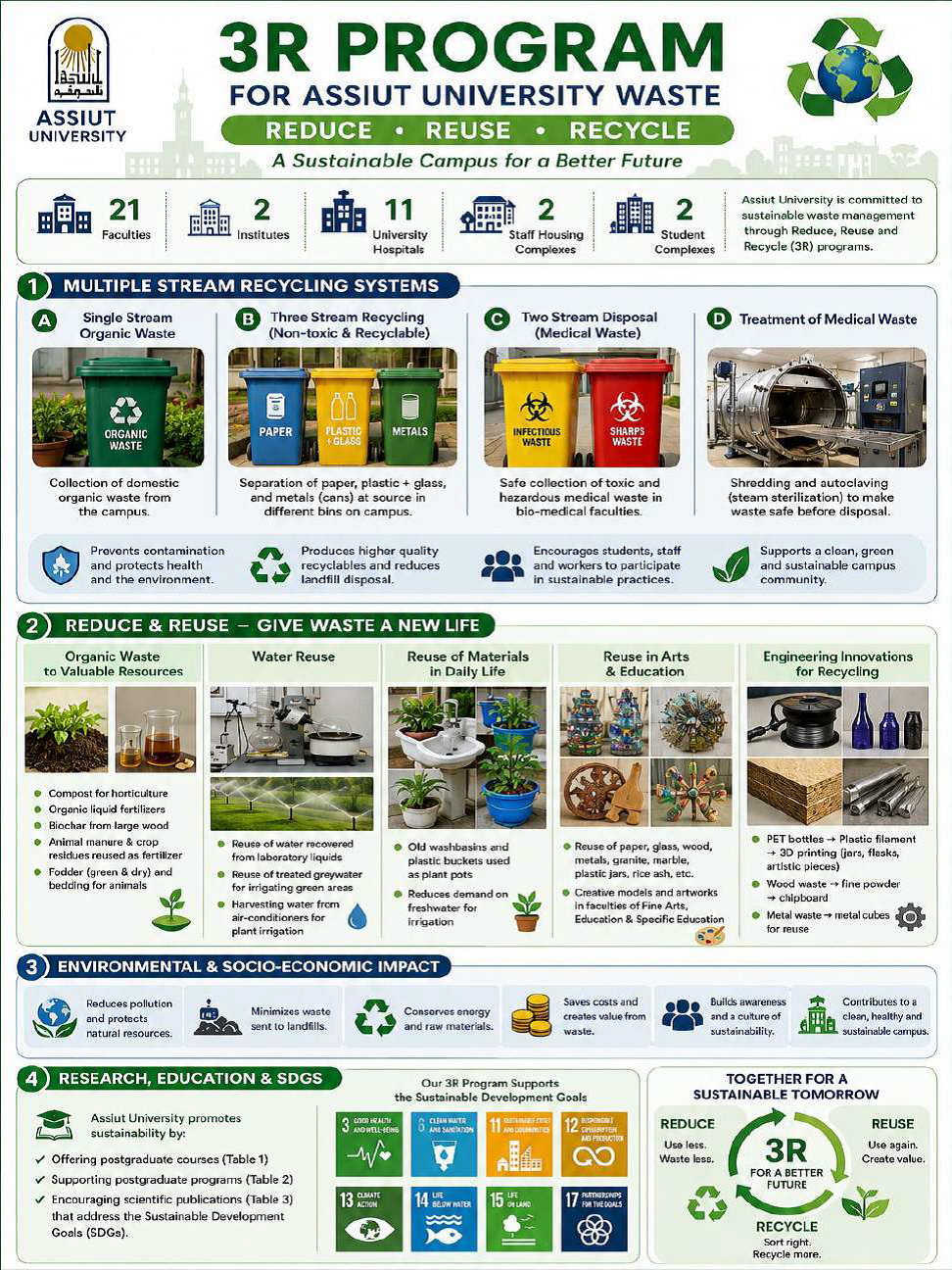
Assiut University has a waste-management programme based on the principles of Reduce, Reuse, and Recycle (3R), supported by multiple-stream recycling systems across the campus. Dedicated recycling bins are provided for separating plastics and other recyclable materials. The University also implements practical plastic-recycling and reuse initiatives. For example, the Faculty of Engineering recycles used PET plastic bottles into plastic filament for 3D printing, while other faculties reuse plastic containers in educational, artistic, and landscaping activities. These measures contribute to reducing plastic waste, promoting resource efficiency, and supporting the University's environmental sustainability objectives.
14.3.3 -The University's work directly (research and/or engagement with industries) to maintain and extend existing ecosystems and their biodiversity, of both plants and animals, especially ecosystems under threat
SDG14
Details:
Assiut University conducts research and external engagement relevant to maintaining and extending ecosystems and biodiversity, including activities addressing the Nile River, freshwater ecosystems, plant diversity, agricultural ecosystems, and invasive or destructive pest species.
The following some activities to protect ecosystems and contribute through research, environmental management, and awareness.
Specific projects and initiatives:
Nile River cleanup and community environmental partnership 9–10 April 2025 · Partners: Assiut University, CEMEX (Assiut Cement Company), and the Ferry Nile environmental initiative.
The university organized an awareness seminar on protecting the Nile and supporting local communities, followed by a cleanup campaign in Bosra village, Al-Fath district, Assiut Governorate. Approximately 40 students participated in removing plastic and solid waste from the river environment. The Ferry Nile initiative also works with fishermen to collect and recycle waste, connecting pollution prevention with local livelihoods. The university reported this activity on 9 and 10 April 2025

2. Campus and off-campus plant diversity and green spaces
Assiut University, including its Faculty of Agriculture and university farms, contributing to the maintenance of plant diversity and green infrastructure:
An arboretum in the University Park campus.
An ornamental-plant farm covering approximately four acres.
An extension farm in Assiut Valley used for undergraduate training and faculty research, with an area of approximately 20 acres and a range of plant and animal resources.
These facilities provide a basis for plant cultivation, agricultural experimentation, education, and maintaining campus green spaces. They support ecosystem-related objectives, although the documentation does not establish that all these facilities are designated natural habitats or threatened-species conservation sites.

3. Research and management of destructive agricultural pests
Our university conducts extensive research on local ecosystems, focusing on the conservation of threatened species and the renovation of degraded habitats. For example, the Faculties collaborates with local environmental agencies to study and maintain ecosystems and their biodiversity native plant species that are at risk of extinction.
Oxidative degradation of sulfafurazole drug by chromium trioxide in diferent acidic media: a kinetic and mechanistic study for treating human diseases, they became harmful to the ecosystem if they reach to the environment. Due to … or degradation of antibiotics to save the humans and ecosystem. 2023
https://link.springer.com/article/10.1007/s43994-023-00035-8
Effect of Manure and Compost on the Phytostabilization Potential of Heavy Metals by the Halophytic Plant Wavy-Leaved Saltbush
Responses of Marine Fungi to Heavy Metal Contamination. 2023
https://link.springer.com/chapter/10.1007/978-981-99-5022-5_11
Assessment of Ecological and Health Risks of Potentially Toxic Elements in Soil and Plant Under Long-Term Sewage Wastewater Irrigation
https://pubmed.ncbi.nlm.nih.gov/39394338/
4. Environmental development strategy, 2024–2029
The university announced a 2024–2029 strategic plan emphasizing ecosystem protection, environmental problem-solving, sustainable use of natural resources, international environmental cooperation, and directing scientific research toward sustainable development.
This provides an institutional framework for research and engagement activities, rather than evidence of one specific biodiversity-restoration project.
16.3.4 -The University's neutral platform and "safe" space for different political stakeholders to come together to frankly discuss challenges
SDG16
Details: