Professor El-Menshawy, President of Assiut University, congratulated the students of the Biomedical Engineering Program at the Faculty of Engineering, after the distinguished success they achieved by obtaining financial and technical support from a number of Egyptian donors, stressing that this achievement reflects the quality of the university's educational process, the efficiency of its students, and their ability to provide innovative engineering solutions that meet the needs of society and keep pace with technological developments.
Professor El-Menshawy stressed that the university pays great attention to supporting specialized academic programs, encouraging students to innovate and scientific research, and strengthening partnership with state institutions and entities supporting student projects, in a way that contributes to preparing graduates capable of competing in the labor market locally, regionally and
internationally, praising the efforts of the Faculty of Engineering, program management and faculty members in providing an educational environment that stimulates creativity and excellence.
This came in light of the report submitted by the Faculty of Engineering, under the supervision of Dr. Khaled Salah, Dean of the Faculty, and Dr. Mohamed Safwat Abouria, Vice Dean for Education and Student Affairs, which was prepared by Dr. Abdel Rahman Ahmed Ali Morsi, Coordinator of the Biomedical Engineering Program, during which he explained that all the five graduation projects in the program for this year, which are five projects, succeeded in obtaining financial and technical support from some Egyptian donors.
The report explained that the "Smart Kids Incubator with Advanced IoT Features" project received support from the Information Technology Industry Development Authority (ITIDA) with a value of EGP 29,380, under the supervision of Dr. Nabil Sabbour Nafie and Dr. Abdulrahman Ahmed Ali, and implemented by the students: Irene Sevin, May Ahmed, Mustafa Yahya, Omar Mohamed, Hana Alaa, Habiba Ahmed, Esraa Ayman, Rinad Mohamed, Mariam Mohamed, and Asma Hassan.
The project "Smart Vehicle Accident Avoidance System Based on Vital Data" also received support from the Information Technology Industry Development Authority (ITIDA) with a value of EGP 45,000, supervised by Dr. Nabil Sabbour Nafie and Dr. Abdel Rahman Ahmed Ali, and implemented by the students: Karen Amjad, Mohamed Hamdi, Mina Rafat, David Michael, Maureen Magdy, Omar Khaled, Mirna Ibrahim, Mahmoud Wael, Gloria Ashraf, and Mustafa Hossam.
The "Smart Alert Vest to Avoid Child Sexual Abuse" project won the support of the Academy of Scientific Research and Technology with a value of EGP 40,489, to be one of only two projects from Assiut University to receive this support, under the supervision of Dr. Nabil Sabbour Nafie and Dr. Abdel Rahman Ahmed Ali, and implemented by the students: Marina Albert, Elia Onsi, Sara Mohamed, Cyril Hani, Mohamed Mahmoud, and Salma Mahmoud.
The project "Artificial Arm Under the Elbow Controlled by Superficial Electro muscular Signals Based on Deep Learning" also received support from Misr El Kheir Foundation with a value of EGP 38,000, under the supervision of Dr. Mohamed Abbas Abdel Radi, and implemented by students: Al-Baraa Aboul Fotouh, David Abdel Masih, Mohamed Sherif, Salma Hisham El-Din, Yissa Mina, Mina Badr, Anwar Abdel Hafez, Youssef Osama, Mary Talaat, Iman Mohamed, Hassan Ahmed, and Amr Khaled.
The project "Designing and Implementing Glasses as an Artificial Intelligence-Based Visual Assistant for the Blind" succeeded in obtaining support from the Egypt Makes program by providing the necessary tools to implement the project, under the supervision of Dr. Khalil Ismail Khalil and Dr. Islam Mohamed Ahmed, and implemented by the students: Abadir Marzouk, Peter Bassem, Youssef Mohamed, Mohamed Ali, Mahmoud Farghal, Mahmoud Khaled, Cyril Sameh, David Mansi, Mohamed Atef, and Mohamed Hatem.
For his part, Dr. Khaled Salah, Dean of the Faculty of Engineering, congratulated the students of the program and the members of the supervisory board on this achievement, stressing that it embodies the ability of the students of the college to compete with their peers in various Egyptian universities, and reflects the confidence of the funding bodies in the level of their projects and innovative ideas, praising the efforts of the program management and the members of the supervisory board that contributed to achieving this success.
The Dean of the Faculty also thanked and appreciated the supporting bodies, namely: the Information Technology Industry Development Authority (ITIDA), the Academy of Scientific Research and Technology, Misr El Kheir Foundation, the Egypt Manufacture Program, and other entities that contribute to supporting student projects, appreciating the support of the university administration headed by Professor El-Menshawy, and Prof. Dr. Ahmed Abdel Mawla, Vice President for Education and Student Affairs, and their continuous keenness to develop the educational and applied process at the college.
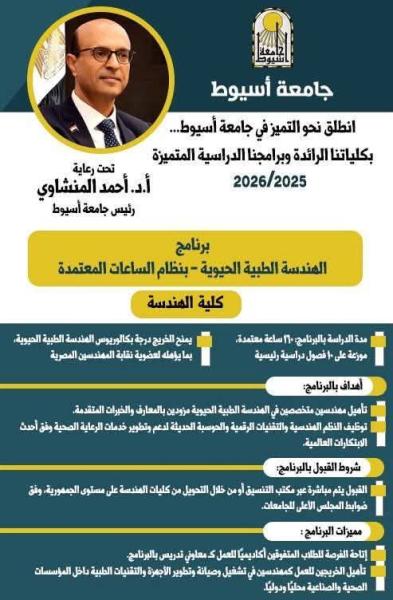
Dr. Abdel Rahman Ahmed Ali Morsi, Coordinator of the Biomedical Engineering Program, explained that the program aims to prepare specialized engineers who possess the necessary expertise and knowledge to apply engineering systems, digital technologies, and modern computing in the fields of healthcare, in line with the latest global developments.
He added that the study in the program extends for ten semesters with a total of 160 credit hours, after which the graduate obtains a bachelor's degree in biomedical engineering, which qualifies him for membership in the Egyptian Syndicate of Engineers, and the program is accepted from students admitted to the college through the coordination office or through transfer from engineering faculties at the level of the Republic, in accordance with the regulations of the Supreme Council of Universities, pointing out that the program qualifies its graduates to work in the design, operation, maintenance and development of medical devices and technologies within health and industrial institutions, to meet the needs of the market Work locally and internationally.