The Quality Assurance Unit’s Board of Directors holds its first meeting for the 2026–2027 academic year.

The Quality Assurance Unit Board holds its first meeting for the 2026-2027 academic year.

On Tuesday, October 27, 2026, the Faculty’s Quality Assurance Unit Board held its first meeting of the year. The meeting was chaired by Professor Khaled Salah, Dean of the Faculty, and attended by Professor Shehata El-Dabaa Abdel-Rahim, Vice Dean for Postgraduate Studies and Research (representing the Faculty’s Vice Deans); Professor Atef El-Naqeeb (representing the Heads of Departments); Professor Mahmoud Eneeb Othman, Director of the Unit; Dr. Adham Mokhtar, Deputy Director of the Unit; Engineer Nevin Salah Deif, from the Office of Experts at the Ministry of Justice in Asyut (representing employers); and student Mohamed Wael Fares (representing the Faculty’s student body).

The agenda covered several significant topics, including responses to feedback gathered through surveys conducted by the Quality Assurance Unit to assess the performance of the Faculty’s leadership and the satisfaction levels of various stakeholders. A draft plan for the professional development of the Faculty’s personnel was approved, pending its submission to the departmental councils. Furthermore, the Board approved an amendment to the Unit’s composition—specifically to increase the number of faculty members serving on the Board—subject to final approval by the Faculty Council.

The meeting also addressed other key matters relevant to the Unit’s operations.

1
1
1
 

Collaboration between Assiut University, the New Valley Governorate, and the Faculty’s Center for Engineering Studies and Consultations

In the presence of the Ministers of Higher Education, Local Development, and Environment:

The President of Assiut University has signed a cooperation protocol between the university and the New Valley Governorate to develop "visual urban identity" studies for the governorate’s cities, to be carried out by the Faculty of Engineering’s Center for Engineering Studies and Consultations.

According to Assiut University Media:

On Wednesday, October 28, 2026, Dr. Ahmed Abdel-Mawla, President of Assiut University, and Dr. Hanan Magdy, Governor of the New Valley, signed a joint cooperation protocol. The agreement aims to develop a visual urban identity for the cities of the New Valley Governorate—one that reflects their unique cultural, civilizational, and environmental characteristics—while also enhancing their tourism and investment potential. This initiative will be executed through the Center for Engineering Studies and Consultations at the Faculty of Engineering, Assiut University.

The signing took place in the presence of Dr. Abdel-Aziz Konsowa, Minister of Higher Education and Scientific Research (also serving as Acting Minister of Culture), and Dr. Manal Awad, Minister of Local Development and Environment. The ceremony was held at the headquarters of the Ministry of Local Development and Environment in the New Administrative Capital. This protocol comes as part of an effort to strengthen cooperation between state institutions and Egyptian universities, leveraging scientific and research expertise—particularly in engineering—to support local sustainable development plans, in alignment with the goals of Egypt Vision 2030.

Dr. Ahmed Abdel-Mawla emphasized that the protocol represents a significant step toward fostering integration between government institutions and Egyptian universities. It aims to harness academic and research capabilities to support development initiatives in the New Valley Governorate by creating a comprehensive visual identity for the governorate’s cities—one that highlights their spatial, urban, and heritage features, while reflecting their unique cultural, civilizational, and environmental characteristics.

The university president explained that Assiut University is committed to applying its scientific and engineering expertise to serve society and bolster development efforts across the governorates. He noted that the collaboration will draw upon the specialized expertise of the Center for Engineering Studies and Consultations at the Faculty of Engineering to conduct the necessary studies—studies that will help showcase the distinct character of the New Valley’s cities and enhance their appeal for tourism and investment.

Dr. Ahmed Abdel-Mawla added that, under the protocol, the university will provide the necessary scientific, technical, and professional personnel—including faculty members and specialists—along with its research and technical resources. These will be used to carry out historical and urban studies, identify the unique spatial and heritage attributes of each city, and develop a comprehensive vision for their visual identity, all while taking into account the specific nature and needs of the governorate. This collaboration is expected to contribute to developing a clear vision for the visual identity of the cities in the New Valley Governorate—a vision rooted in their urban, heritage, cultural, and environmental assets. By leveraging the specialized academic and technical expertise available at Assiut University, this initiative will support the governorate’s efforts to highlight its unique character and maximize the use of its potential to foster tourism and investment development.

1
1

The Dean of the College receives the founder of the Institute for the Rights of Civilization in the United States of America.

The Dean of the College receives the founder of the Institute of Civilizational Rights in the United States of America..

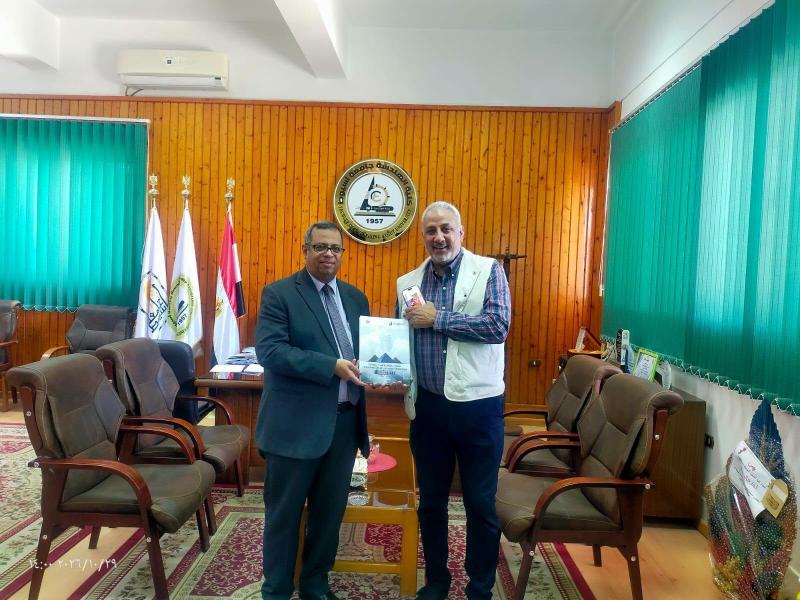
Professor Dr. Khaled Salah, Dean of the Faculty of Engineering at Assiut University, received Professor Dr. Ahmed Yahya Rashed, founder and president of the Civilization Rights Institute in the United States of America, today, Thursday, October 29, 2026.

The Dean of the College expressed his happiness at receiving one of the College’s distinguished sons, praising his academic and professional career in architecture, urban planning, and heritage preservation, and his efforts in transferring the idea of ​​“the rights of a civilization to build a civilization” from a national initiative to an international scientific institution.

Dr. Ahmed Rashid gave a brief presentation about the Institute, which is an American non-profit scientific research institution that aims to set standards for ethical dealing with cultural heritage and protecting the right of communities to their cultural heritage. The Universal Declaration of the Rights of Civilization, which designates June 10 of each year as the Day of the Rights of Civilization, discussed the science of civilizations and the concept of the resilience of civilizations in the face of challenges and shocks. He also reviewed the Institute's cooperation experience with Egyptian universities, including Badr University and Horus University, and the training programs it implemented for faculty members and students.

During the meeting, the two sides discussed ways of joint cooperation, including studying a cooperation protocol and organizing workshops, lectures, and joint research projects in heritage and sustainability in a way that serves scientific research, student rehabilitation, and community service.

Professor Dr. Ahmed Rashid presented copies of the book “Civilization Rights to Build Civilization,” which he wrote, to the college, to be a reference for faculty members, researchers, and students interested in heritage, sustainability, and the rights of peoples to the heritage of their civilizations.

At the conclusion of the meeting, the Dean of the College presented the College Shield to Dr. Ahmed Rashid in appreciation of his efforts and great history, and both parties affirmed their keenness to continue communication and deepen relations between the College and the Institute.

Participating in attendance were Professor Dr. Shehata Al-Dabaa Abdul Rahim, Vice Dean of the College for Graduate Studies and Research, Professor Dr. Mahmoud Aneeb Othman, Director of the Quality Assurance Unit at the College, and Professor Muhammad Ali, Director of Public Relations at the College.

It is worth noting that Professor Dr. Ahmed Rashid began his academic career at Assiut University as a student in the Department of Architectural Engineering, then as a teaching assistant, assistant lecturer, and teacher. Then he moved to work at Mansoura University and from there to the British University, ending with the establishment of the Civilization Rights Institute in the United States of America. Assiut University honored him last December on the Scientific Day for Assiut University graduates as one of Egypt’s distinguished scholars from the university abroad.

1
1
1
1
1
1

The Dean of the Faculty receives the Asyut Robotics team

The Dean of the Faculty received the "Assiut Robotics" team following their win of the "Best Mechanical Design" award at the *Minesweepers: Towards a Landmine-Free World* competition, held at Zewail City of Science and Technology.

Professor Khaled Salah, Dean of the Faculty, welcomed the Assiut Robotics team after their outstanding participation in the 2026 edition of the international *Minesweepers: Towards a Landmine-Free World* competition. The event took place on October 17, 2026, at Zewail City of Science and Technology, where the team secured the "Best Mechanical Design" award, outperforming all other participating teams in terms of engineering and design.

Also present to welcome the team were Professor Mazen Abdel-Salam, the team’s scientific supervisor; Dr. Mohamed Eid Abdel-Mawla, supervisor of scientific activities at the Faculty; and Mr. Mohamed Sharaqa, Director of the Student Welfare Department.

The competition is considered one of the most prominent engineering forums dedicated to the development of robots for landmine detection and removal.

The robot was designed to navigate rugged terrain, detect both surface and buried landmines, map their locations, and subsequently retrieve them—all through an integrated engineering system.

The Dean of the Faculty congratulated the team and their supervisors on this remarkable achievement, wishing them continued success in future endeavors and competitions.

1
1

The graduation project "Smart Automated Plastic Recycle System" (SAPRS) has won the Sustainability and Localization Award.

The graduation project, "Smart Automated Plastic Recycle System (SAPRS)," has won the "Sustainability & Localization Award" at the "Egypt Makes 2026" competition. The project focuses on recycling plastic waste to produce sustainable interlocking paving blocks.

A team from the Faculty of Engineering at Assiut University—supported by the Academy of Scientific Research and Technology—successfully designed and manufactured a smart machine that converts plastic waste into high-durability interlocking tiles. The project, developed for the 2025–2026 academic year, integrates artificial intelligence, the Internet of Things (IoT), and Fourth Industrial Revolution technologies.

Named "Eco Lock," the project is an outcome of the "Egypt Makes" (Misr Tasna') alliance, backed by the "My Project, My Beginning" (Mashrou'i Bidayati) initiative. It aims to recycle plastic waste into sustainable construction materials, thereby helping to reduce pollution and maximize resource utilization.

Preliminary tests have demonstrated that the interlocking tiles—made from recycled plastic—can withstand compressive loads of up to 8 tons, confirming their efficiency and suitability for a wide range of applications.

The project was developed by the following graduates:

Eng. Pavly Magdy Zakher

Eng. Walid Khaled Mustafa

Eng. George Raef Sami

Eng. Mira Tharwat Girgis

Eng. Samuel Raafat Kamal

Eng. Mina Habib Bakhit

Eng. Yustina Naseef Samir

Eng. Anton Natai Tawfiq

Eng. Bishoy Bahaa Botros

Eng. Fadi Mamdouh El-Gamil

Eng. Mohamed Omar Badri Bishoy Rifaat Methenni

Eng. Mostafa Hammam Hassan

Eng. Bahaa Romani Ayoub

Eng. Nader Samir Mahawad

The project was supervised by Prof. Ahmed Saad Ali, Dr. Gamal Abdel Nasser, and Dr. Abdullah Farraj Abdel Rahim, with Dr. Ahmed Mohamed Attia serving as the team’s advisor.

For his part, Prof. Khaled Salah, Dean of the Faculty, congratulated the graduates who developed the project, as well as their supervisors, on receiving this award. He noted that the achievement reflects the high quality of the educational process at the Faculty, as well as the capabilities and skills of its students and graduates. He also extended his gratitude to the university administration—led by the University President, Prof. Ahmed Abdel Mawla—for his support of the educational process and for encouraging student participation in various local and international forums and competitions.

1
1
 
1
1
1
1
 
1
1

Development of an Accelerated Thermal Cycling Test Setup and Machine-Learning-Based Lifetime Prediction of IGBT Modules in Inverter Operation

Research Abstract

The reliability of Insulated Gate Bipolar Transistor (IGBT) modules is critical for long-term durability and operational stability in power electronic systems. This paper presents a real-time degradation-monitoring and lifetime-prediction framework for IGBT modules using accelerated power-cycling tests under realistic inverter conditions. A two-level SVPWM inverter is used, with electrically driven current loading and developed induction heating, along with an active water-cooling system, to create precise junction-temperature swings to investigate thermal fatigue. Continuous acquisition of on-state voltage and temperature data is performed throughout the aging of six IGBT modules under two junction-swing conditions. The degradation behavior is examined through experimentally observed trends and used to develop a machine-learning model based on Random Forest (RF) to predict the remaining useful lifetime (RUL) utilizing the extracted degradation indicators. A comparative analysis with a Support Vector Regression (SVR) and Gaussian Process Regression (GPR) models is performed to validate the RF model’s effectiveness, confirming that the RF model has greater accuracy, robustness, and computational efficiency with limited datasets. The proposed framework thus integrates experimental testing, and data-driven prediction, attaining lifetime-prediction errors under 4% while utilizing only 20–60% of the lifetime data, offering a precise and scalable method for assessing inverter-level IGBT reliability.

Research Authors
Ahmed H Okilly, Cheolgyu Kim, Seungdeog Choi, Jeihoon Baek
Research Date
Research Department
Research Journal
IEEE Journal of Emerging and Selected Topics in Power Electronics
Research Member
Research Publisher
IEEE
Research Rank
International Journal, Q1 WOS, Q1 Scopus, IF 5.7
Research Website
https://ieeexplore.ieee.org/abstract/document/11481045
Research Year
2026

Cyber-Physical Radiative EMI Attacks on Sensorless Motor Drives: Destabilization, Adaptive Torque Manipulation, and Physics-Based Detection

Research Abstract

Electromagnetic interference (EMI) is an emerging cyber–physical threat to sensorless motor drives that rely on accurate current feedback. This paper presents an experimental study of radiative EMI attacks on a three-phase GaN inverter operating under sensorless field-oriented control. Specifically, non-contact EMI intrusion is investigated to examine how it may disrupt current sensing and electrical angle estimation, resulting in torque degradation and eventual loss of synchronism. Beyond instability, an adaptive EMI attack is presented in which disturbance amplitude is adjusted using only an external rotor speed measurement and a simple mechanical torque estimator to steer the drive toward a malicious torque operating point without access to internal controller variables, demonstrating that EMI can function as a controllable analog attack channel rather than a random disturbance. Additionally, a physics-based detection technique is proposed that provides early, low-latency attack detection under the tested conditions by tracking torque consistency across the mechanical and electrical domains. Experimental results demonstrate the effectiveness of both the adaptive attack and the proposed detector.

Research Authors
Peter Harmony, Md Moniruzzaman, Ahmed H. Okilly, Jeihoon Baek, Seungdeog Choi
Research Date
Research Department
Research Journal
IEEE Journal of Emerging and Selected Topics in Power Electronics
Research Member
Research Publisher
IEEE
Research Rank
International Journal, Q1 WOS, Q1 Scopus, IF 5.7
Research Website
https://ieeexplore.ieee.org/document/11749530
Research Year
2026
Subscribe to