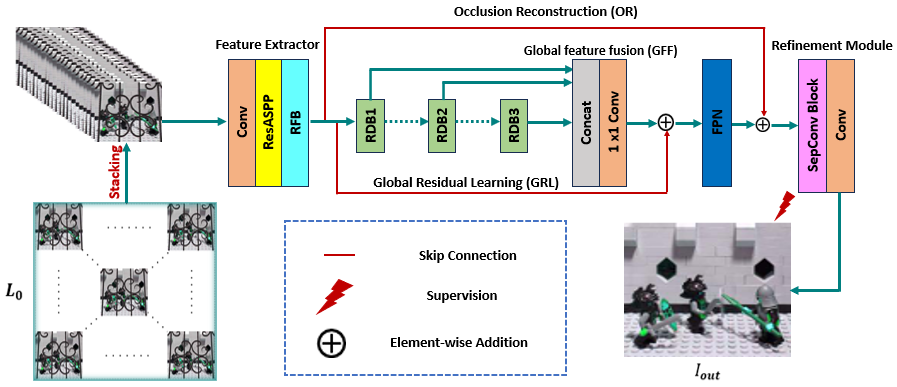
Removal of occlusions in light-field (LF) images is strongly influenced by the receptive field of the neural network. Existing methods often suffer from limited receptive fields, restricting their ability to capture long-range dependencies and recover occluded regions effectively. To overcome this, we propose LF-PyrNet, a novel end-to-end deep learning model that enhances occlusion removal through multi-scale receptive field learning and hierarchical feature pyramid-based refinement. Our model consists of three key components. First, the feature extractor expands the receptive field by integrating Residual Atrous Spatial Pyramid Pooling (ResASPP) and a modified receptive field block (RFB). These components allow the model to capture broader context and multi-scale spatial dependencies. Next, the core occlusion reconstruction network consists of three cascaded Residual Dense Blocks (RDBs). Each block contains four densely connected layers. A Feature Pyramid Network (FPN) then performs multi-scale feature fusion and refines the representations effectively. Finally, the refinement module, which incorporates both separable and standard convolutions, enhances detailed structural consistency and improves texture restoration in occluded regions. Experimental results show that expanding the receptive field significantly enhances the occlusion removal performance, making LF-PyrNet a reliable solution for reconstructing occluded regions in LF images.