


Congratulations to Professor Dr. Tayseer Hassan Abdel Hamid on the students' victory in the college swimming league.
Recreational Games League

Under the patronage ofProf. Dr. Tayseer Hassan Abdel Hamid – Dean of the College
Prof. Dr. Khaled Fathi Hussein – Vice Dean for Education and Student Affairs
And under the supervision of The Student Families Committee
The College's Student Welfare Committee organized a recreational games league on Monday, November 3, 2025.
The event saw the participation of (150) male and female students from various academic years. The league included
a variety of recreational games, including:
• Hoop throwing, with the winner winning four rounds.
• Wrestling, with the winner surviving three consecutive rounds
. • Standing long jump, with the winner achieving the longest distance of 2.25 meters.
• Tug-of-war, with four players on each team, and the winning team surviving two consecutive rounds.
✨ This activity reflects the College's commitment to fostering a spirit of participation and sportsmanship among students, and to developing cooperation and teamwork in an atmosphere of fun and positive interaction.
Activity Coordinator: Dina Talaat
Student Welfare Director: Hossam El-Din Mostafa

Announcement of workshops for participation in the Creativity Festival

Announcement of the basketball competition

Announcing the social research competition for students of families

Training courses offered by the Information Technology Institute, specializing in a distinguished technological field, for graduates of Egyptian universities from 2016 to 2025, at the institute's headquarters in Assiut Governorate.
https://www.facebook.com/share/p/16Q5x1TjuB/
Training Courses Offered in Assiut Governorate The Information Technology Institute announces the opening of registration for intensive training grants in a distinguished technological specialization for Egyptian university graduates from 2016 to 2025 at the institute's headquarters in Assiut Governorate. The courses are as follows: Full Stack Web Development Using MEARN For more information about the specialization, please visit the following link:
https://drive.google.com/.../1FCUYqXP5ub7z8iWXgpv.../view...
2D Graphics Design For more information about the specialization, please visit the following link:
https://drive.google.com/.../13qqxtSv0tEqwf.../view...
- Required documents and registration steps are explained in the registration link. - The training courses will be conducted using a blended learning system. - Registration begins on Saturday, November 1, 2025, and continues until [date missing]. Thursday, November 13, 2025 - Registration is through the following link on the official website of the Information Technology Institute:
https://internal.iti.gov.eg/home
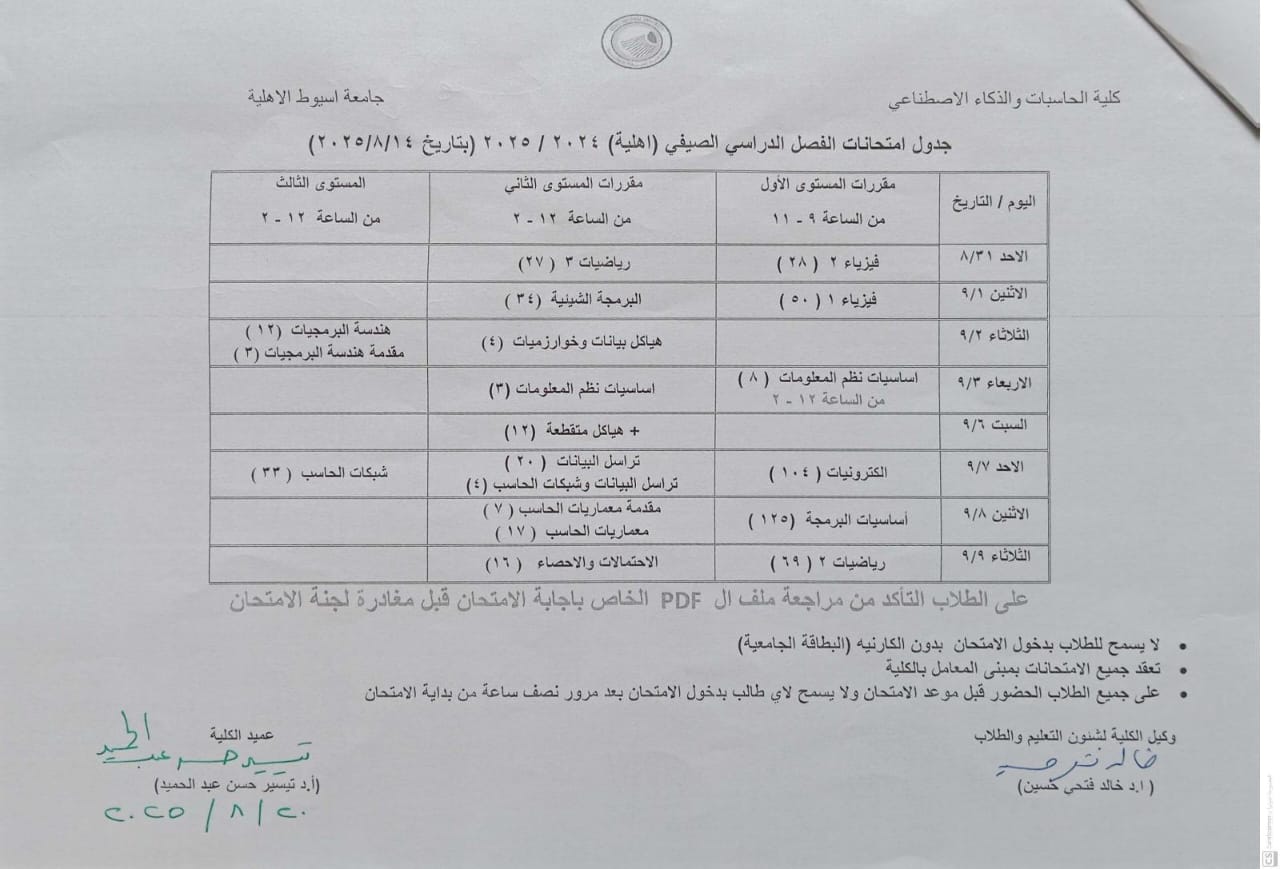
Summer semester exam schedule (eligibility) 2024/2025
Spectral Normalized U-Net for Light Field Occlusion Removal
Research Abstract
Occlusion artifacts significantly hinder light field (LF) image reconstruction, especially in complex scenes. We propose a spectral normalized U-Net for LF occlusion removal, which begins by stacking LF views and extracting view-dependent features using a local feature encoder. To capture spatial complexity, ResASPP enable multi-scale context aggregation, while channel attention enhances occlusion-related features. Spectral normalization is applied to all convolutional layers to improve training stability and generalization. The encoder-decoder structure with skip connections preserves fine details. Experimental results show our method restores occluded regions more accurately than baselines.
Research Date
Research Department
Research File
Research Image

Research Journal
INTERNATIONAL CONFERENCE ON FUTURE INFORMATION & COMMUNICATION ENGINEERING
Research Member
Research Pages
294-297
Research Publisher
Korea Information and Communications Society
Research Vol
16
Research Website
https://www.dbpia.co.kr/pdf/pdfView.do?nodeId=NODE12293106
Research Year
2025
Occlusion removal in light-field images using CSPDarknet53 and bidirectional feature pyramid network: a multi-scale fusion-based approach
Research Abstract
Occlusion removal in light-field images remains a significant challenge, particularly when dealing with large occlusions. An architecture based on end-to-end learning is proposed to address this challenge that interactively combines CSPDarknet53 and the bidirectional feature pyramid network for efficient light-field occlusion removal. CSPDarknet53 acts as the backbone, providing robust and rich feature extraction across multiple scales, while the bidirectional feature pyramid network enhances comprehensive feature integration through an advanced multi-scale fusion mechanism. To preserve efficiency without sacrificing the quality of the extracted feature, our model uses separable convolutional blocks. A simple refinement module based on half-instance initialization blocks is integrated to explore the local details and global structures. The network’s multi-perspective approach guarantees almost total occlusion removal, enabling it to handle occlusions of varying sizes or complexity. Numerous experiments were run on sparse and dense datasets with varying degrees of occlusion severity in order to assess the performance. Significant advancements over the current cutting-edge techniques are shown in the findings for the sparse dataset, while competitive results are obtained for the dense dataset.
Research Date
Research Department
Research File
applsci-14-09332.pdf
(4.74 MB)
Research Image

Research Journal
Applied Sciences
Research Member
Research Pages
(20), 9332
Research Publisher
MDPI
Research Vol
14
Research Website
https://doi.org/10.3390/app14209332
Research Year
2024